Digital Wellness & Focus / Advanced

Attention Athletics

Train your focus like a muscle—with interval training for attention, boredom practice, concentration meditation, and a real way to measure your progress.
10 chaptersEPUB + PDF + HTMLAdvanced guide pricingDRM-free files
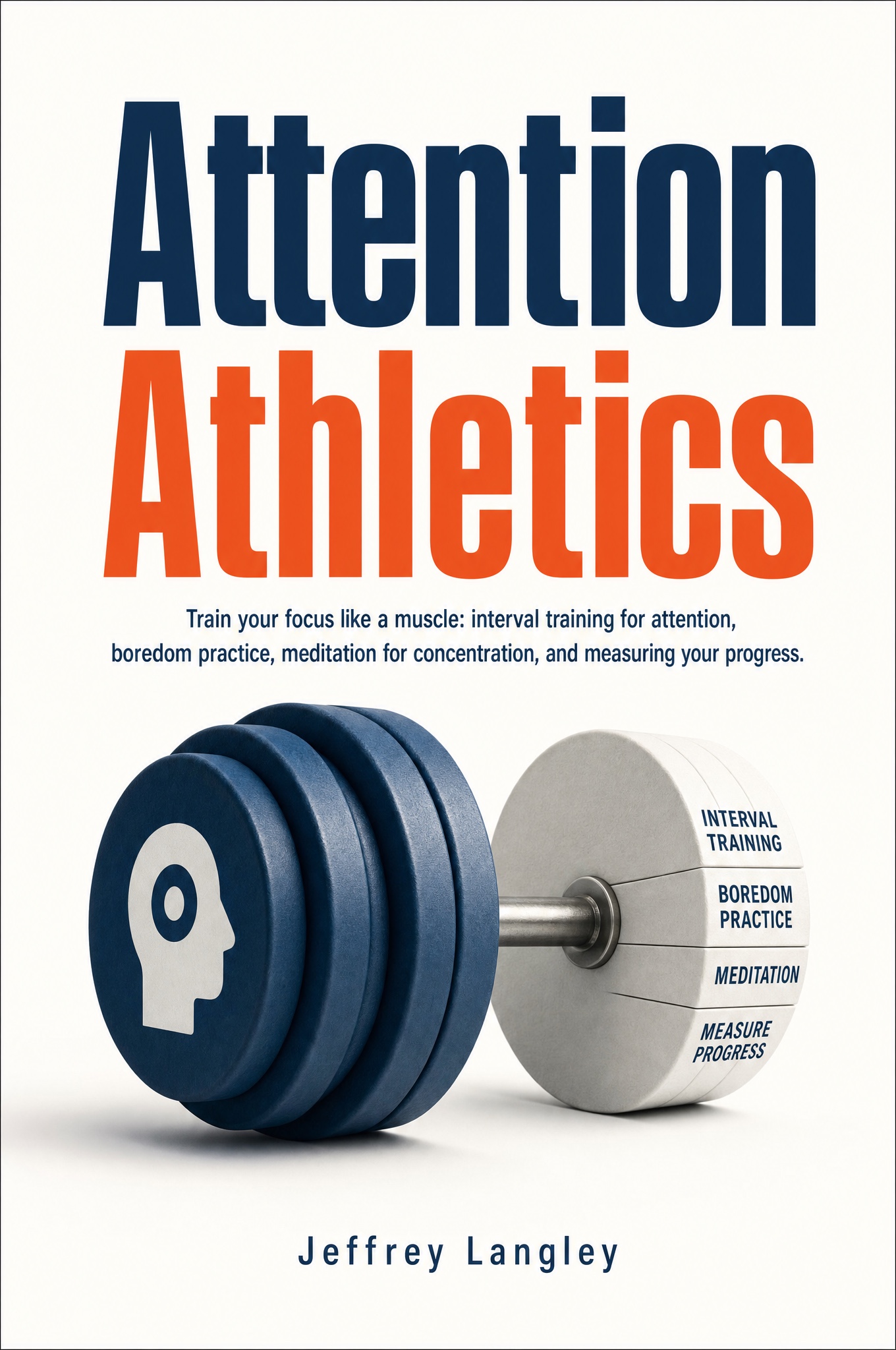
Attention Athletics book cover
The problem

It starts with the situation you're actually in.

Attention isn't a fixed trait—it's a directable, adaptable capacity. Recent trials in athletes show that both focus and pre-performance anxiety shift with deliberate training.

You end up with eight working parts: interval blocks with progressive overload, structured boredom drills, focused-attention meditation, the external-versus-internal focus switch, a recovery architecture, an engineered environment, and a measurement loop that turns effort into a slope you can read.
Outcomes

What you'll be able to do.

The problem with the long-grind default

Most experts jump straight to volume—blocking out a three-hour "deep work" morning, white-knuckling through it, and calling the survived hours training. Run your own numbers first.

The capacity you cannot will into existence

You can decide to concentrate. You cannot decide that concentration arrives.

Friction is a lever, and you control which way it points

Your trained attention has a problem it can't solve from the inside. You sit down Monday and the laptop opens to seventeen tabs, the phone sits face-up beside the keyboard, a notification slides in from the corner, and the messaging badge reads 12.

The measurement you already failed at

You've probably tried to track your focus before, and quit. The pattern is predictable: you download an app, log diligently for four days, miss one, feel the gap as failure, and abandon the record by week two.

Inside the book

A closer look at the work inside.

Why this matters: an expert reader's checklist

  • Attention is a directable, adaptable, bounded capacity, not a fixed trait — recent athlete trials show specific interventions move specific outcomes (anxiety, fatigue, search.
  • The muscle analogy transfers as logic — overload, recovery, specificity, periodization — but not as biology; reject linear, permanent, single-score thinking.
  • Three levers govern everything ahead: load, adaptation, and specificity. Name your target and your real attentional demand before you train.
  • Next, another chapter turns this foundation into a personal attentional profile, so you train your actual bottleneck instead of your strongest sub-skill.

Diagnosing a "focus problem" with the three levers

Say your real complaint is that you can't sustain deep analytical work past 25 minutes before reaching for your phone. Run it through the levers instead of resolving to "focus more": the demand is sustained attention on low-novelty cognitive work—not selective filtering, not task-switching.

The three levers every protocol pulls

Strip the science down and three control variables run the entire program. Hold these and you can design or debug any practice in the book. Load comes first—how hard and how long you ask attention to work: block duration, task difficulty, distraction level, novelty.

Assemble your profile

Work through this once. It produces the baseline every later chapter trains against.
  • Logged attention breaks for five working days using the fixed shorthand.
  • Sorted breaks into internal versus external triggers.
  • Ran at least two repeatable micro-tests and recorded raw numbers (re-engage seconds, error rate, time penalty).
  • Listed your three highest-value recurring tasks and labeled each one's dominant component.

The "I just need to focus more" trap

  • Attention is not one capacity. Sustained, selective, alternating, and divided attention dissociate — strength in one says little about the others, because the type of practice that.
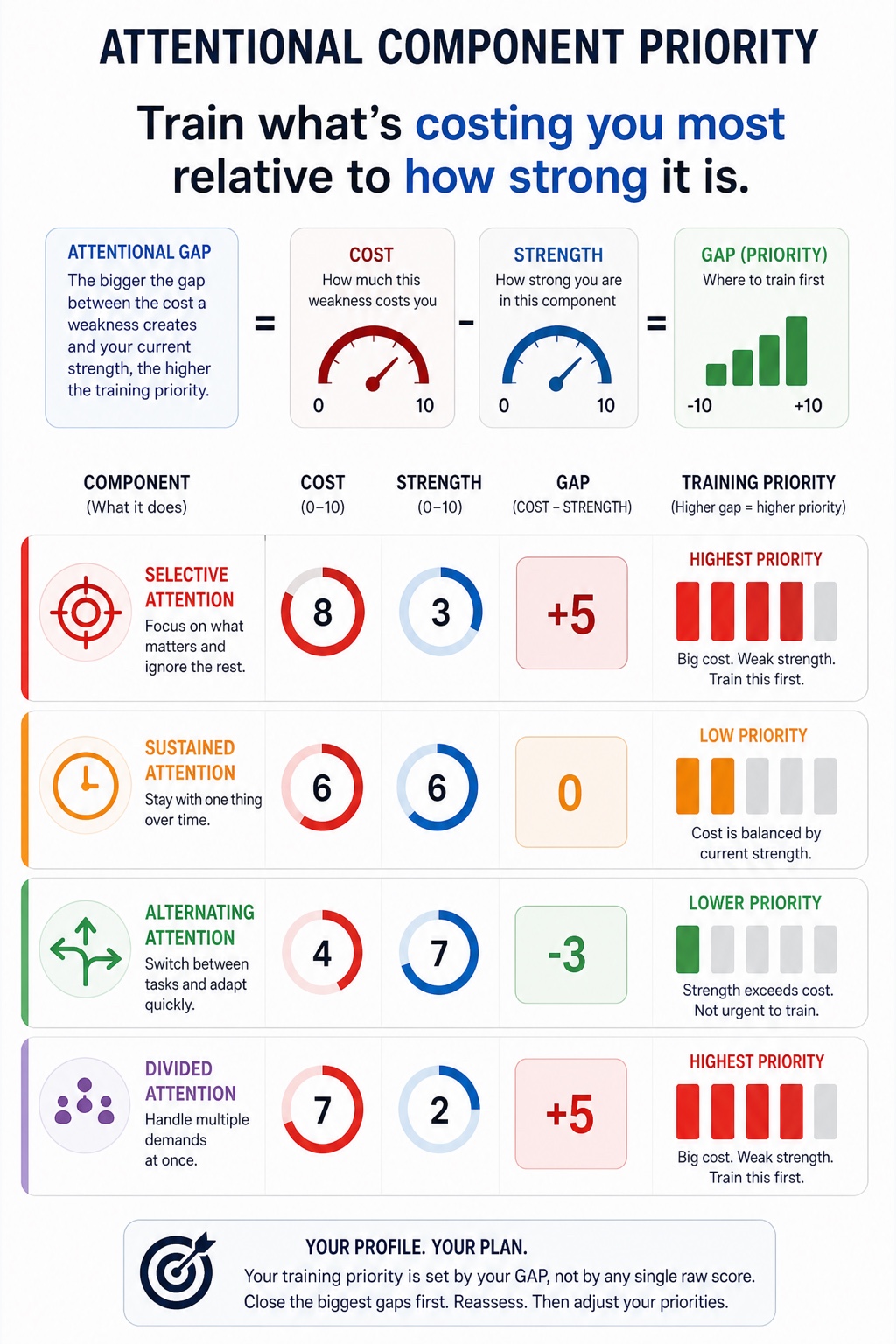
  • A single focus score hides your real constraint. Build a profile (a vector), then target the largest gap between a component's demand and your measured capacity.
  • Use three lenses together — a five-day break log, repeatable micro-tests, and demand mapping of your high-value work — so no single biased source sets your priority.
  • Name your bottleneck and your strongest component, so later protocols train the deficit instead of rehearsing a strength.
  • Re-score every four to six weeks; a profile is a snapshot, not a verdict.
  • Next, another chapter takes your priority component into structured interval training, titrating load and recovery so you build that capacity without manufacturing junk-focus volume.
Attention Athletics visual framework
Attention Athletics frameworkInside the book
Visual preview

A diagram you can keep open while you work.

Table of contents

10 chapters, built to be read in order.

01

Attention Is a Trainable System

02

Profiling Your Attention Before You Train

03

Interval Training for Attention

04

Boredom as a Training Stimulus

05

Focused-Attention Meditation as Concentration Strength Work

06

Directing the Beam—External and Internal Focus

07

Distraction Resistance and Attentional Recovery

08

Engineering the Training Environment

09

Instrumentation—Measuring and Progressing Your Focus

10

Building the Durable Practice

154
Pages
15,066
Words
31
Exercises, checklists & tools
10
Chapters
Formats

Three formats. One purchase.

EPUB, PDF, and HTML are included so the book can work on an e-reader, as a designed copy, or as a searchable desk reference.

EPUB

For e-readers and reading apps.

PDF

The designed edition with diagrams and layouts intact.

HTML

Searchable, copy-pasteable, and practical as a reference.

Complete guide

Attention Athletics

$12.99
Advanced guide pricing
  • EPUB + PDF + HTML included in one purchase
  • 10 chapters from the complete guide
  • DRM-free files for your own devices
  • 7-day refund review for duplicate purchases, access issues, wrong files, or materially defective downloads
Add to cart - $12.99
Secure checkout / instant download / tax handled at checkout
Before you buy

Questions, answered.

Does this include the full book?

Yes. You get the complete edition, including the chapter sequence and internal materials described on this page.

Which formats are included?

EPUB, PDF, and HTML are included so you can read on an e-reader, keep a designed copy, or use the searchable browser version.

What is the refund policy?

Because this is an instant digital download, broad change-of-mind refunds are not offered after the files have been accessed. Refund requests are reviewed within 7 days for duplicate purchases, accidental purchases before access, access failures we cannot fix, wrong files, corrupted files, or pages that materially misdescribe the book.