Score the harm, not the technology
You get a defensible answer to the question an auditor, a customer's security team, or your own board will eventually ask: why is this use case acceptable and that one not? "It felt fine" won't hold.
Turn voluntary AI commitments into enforceable guardrails—a practical governance blueprint for teams navigating the EU AI Act and US regulations.

Most AI policies are written to be read once and filed: they open with values—fairness, transparency, human oversight—and close with a senior signature. The real work is closing the distance between what your organization says about AI and what your systems actually enforce.
A control you wrote in March can be wrong by June without anyone touching it. Your vendor ships a new model version and silently routes your traffic to it. Voluntary commitments and one-time projects share this failure mode: they assume a fixed target.
You get a defensible answer to the question an auditor, a customer's security team, or your own board will eventually ask: why is this use case acceptable and that one not? "It felt fine" won't hold.
A prompt that says "never reveal customer Social Security numbers" holds until someone asks the model to "summarize this account in the style of a verification script," and the number comes out anyway. You get a clean test for whether a guardrail is real.
You build your controls once, then map them so a procurement officer in Munich, a state attorney general's office in Texas, and your own board's audit committee can each read them in their own language.
Your detection system flags a customer-support agent that has been quietly issuing refunds it was never authorized to approve—and the first one happened eleven days ago. You know how to respond when a guardrail fails.
Before you build anything, measure the gap you're starting from. Pull your current AI policy, code of conduct, vendor commitments, or any "responsible AI" statement, list its distinct principles—aim for five to ten—and score each one honestly against the triad.
Before moving to another chapter, confirm you can answer yes to these.
Take a common line from corporate AI policy—"Sensitive customer data must not be sent to external AI models"—and watch it move from aspirational to enforceable, as an unassigned promise gains a named owner, a mechanism, and a record.
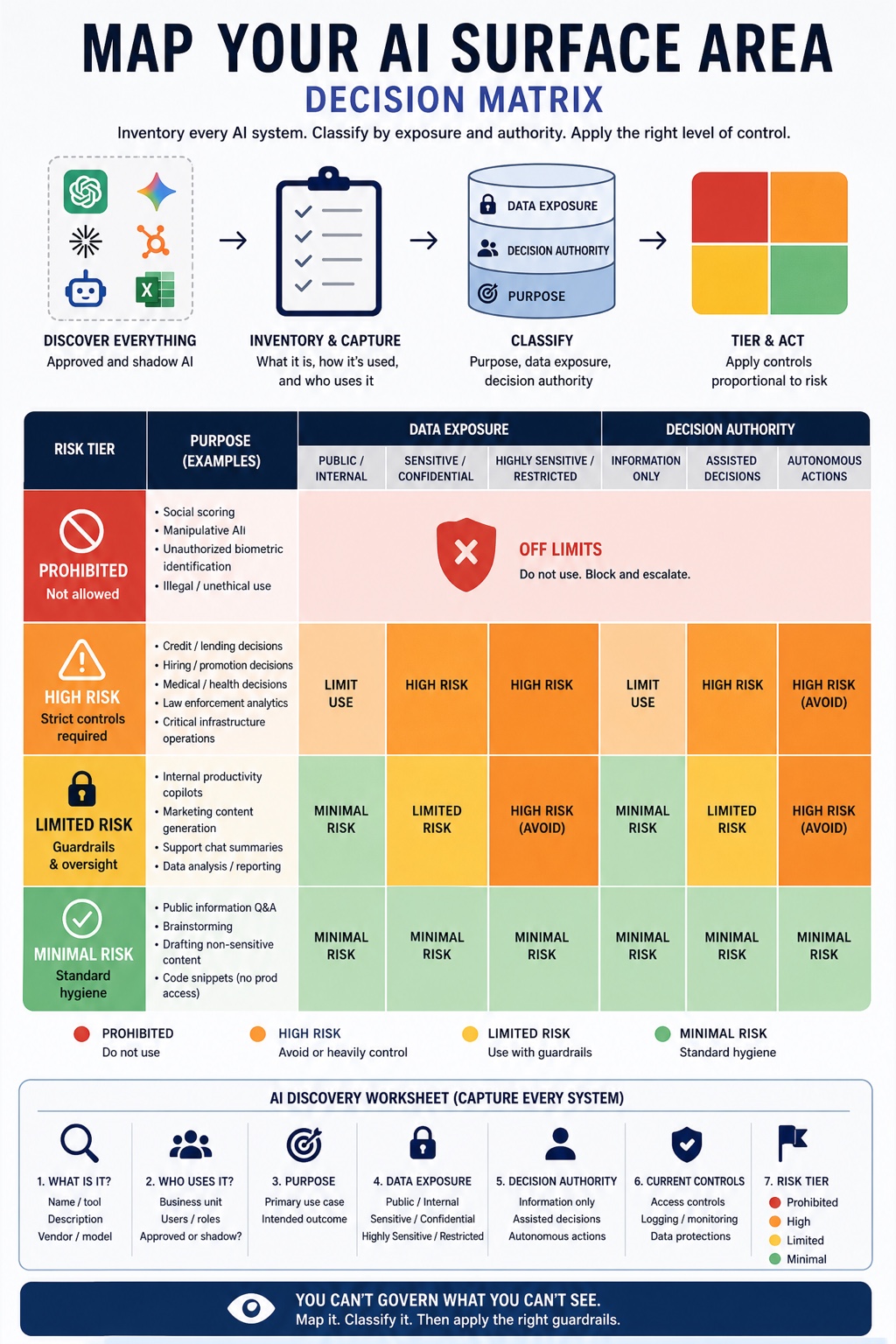
Open a shared sheet and create one row per system you discover, treating the file as a permanent operational record rather than a project deliverable. Columns capture the system or tool name, where it's accessed, and a named owner—a person, not a team.
EPUB, PDF, and HTML are included so the book can work on an e-reader, as a designed copy, or as a searchable desk reference.
For e-readers and reading apps.
The designed edition with diagrams and layouts intact.
Searchable, copy-pasteable, and practical as a reference.
Yes. You get the complete edition, including the chapter sequence and internal materials described on this page.
EPUB, PDF, and HTML are included so you can read on an e-reader, keep a designed copy, or use the searchable browser version.
Because this is an instant digital download, broad change-of-mind refunds are not offered after the files have been accessed. Refund requests are reviewed within 7 days for duplicate purchases, accidental purchases before access, access failures we cannot fix, wrong files, corrupted files, or pages that materially misdescribe the book.