The five-minute problem that costs an afternoon
You sit down to test a sensor, plug in the board, and open the editor — and nothing happens. The port doesn't show up.
Build edge-AI projects on cheap hardware: voice boxes, sensors, and smart toys.
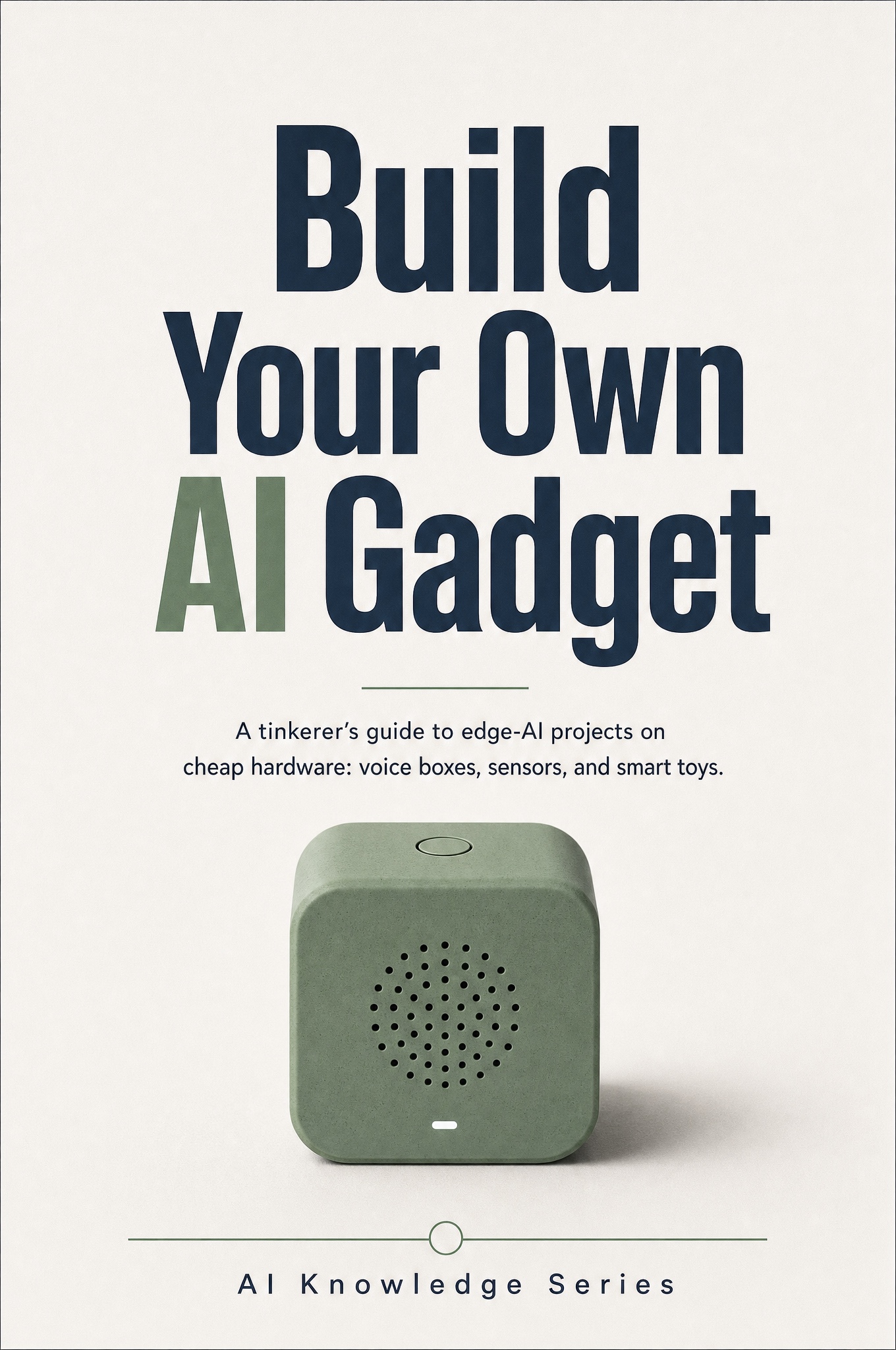
Picture a small device next to your keyboard: a microcontroller the size of a stick of gum, a tiny microphone, a couple of jumper wires, and a speaker pulled from an old toy. It cost less than lunch for four people. That's the wager of this book.
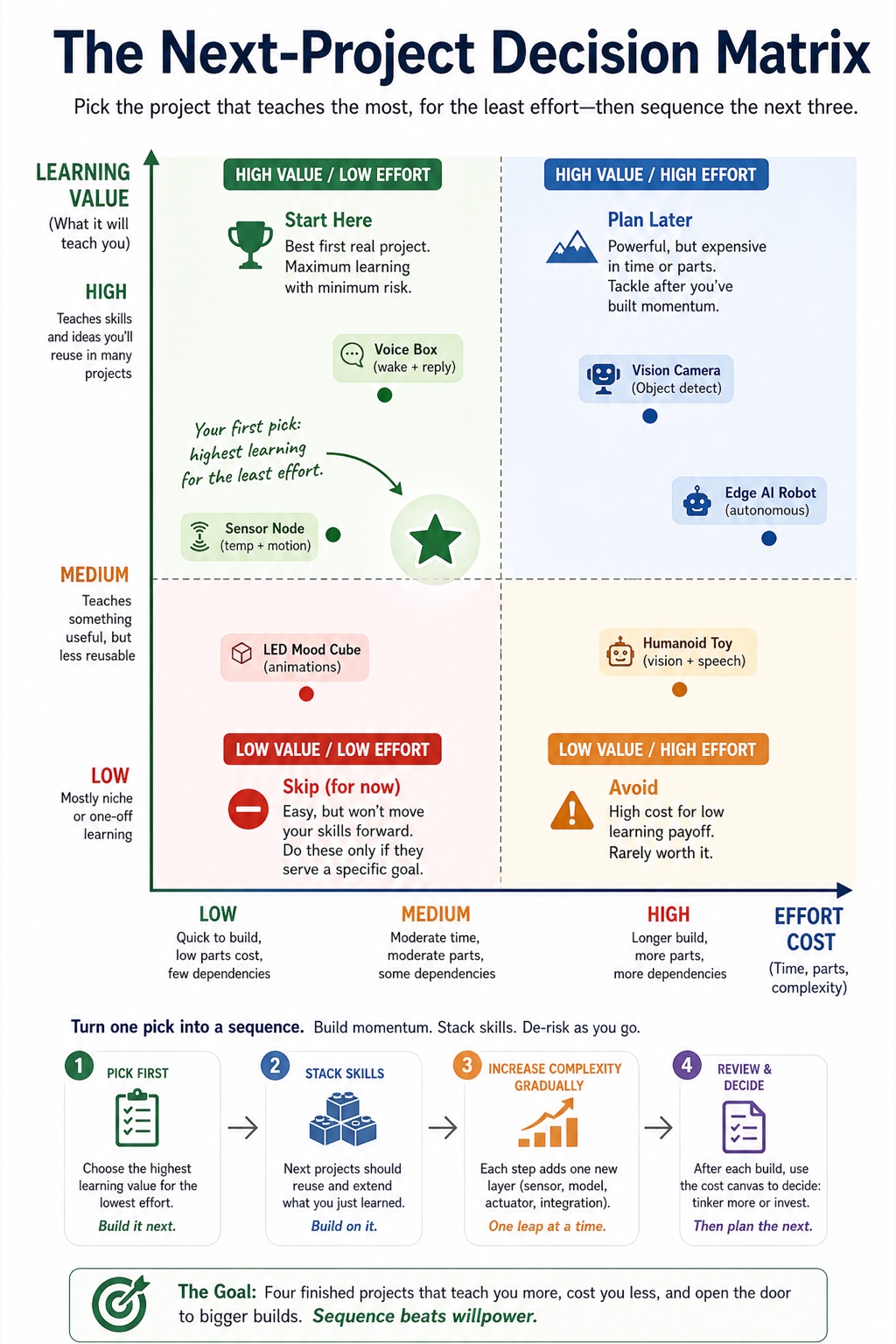
You can run a cost canvas and decide whether a project deserves a second unit — but that answers one question about one build. You turn your worksheets into a single forward plan for your next ten projects.
You sit down to test a sensor, plug in the board, and open the editor — and nothing happens. The port doesn't show up.
You wire a motion sensor to a desk lamp. Twenty minutes later you're reading, perfectly still, and the room goes dark.
Your breadboard works. You've shown three people, and each time it did exactly what you promised.
A breadboard that works is a story you tell yourself. A bill of materials, a privacy obligation, and a regulatory checklist are stories the world tells back.
Say you're weighing a self-hosted voice feature — a private assistant assembled from open wake-word, speech-to-text, and local response tools. Treat the build as an experiment, not a craft project, and frame it as a hypothesis: customers will accept a voice interface that runs locally.
Do this for one build — the project you named for yourself. Score each criterion from 1 (trivial) to 5 (demanding): memory and compute, where 1 is simple threshold logic and 5 is a trained model running on the board; power, where 1 is wall-powered with run-time irrelevant and 5 is battery-only for days in the field.
Take one project family — "a box that knows when someone is at my desk" — and watch the right board change as the requirement sharpens. This is one build described three ways, not three different ambitions. Version A, presence light: a desk light that turns on when motion is detected and off after a quiet minute.
You won't write a useful program here — you'll prove the loop works, which is more valuable. Pick whichever brain you chose. On a microcontroller (Arduino/ESP32), flash the built-in "Blink" example first. If the LED blinks, your compile-and-flash path works, which isolates the toolchain from your wiring.
EPUB, PDF, and HTML are included so the book can work on an e-reader, as a designed copy, or as a searchable desk reference.
For e-readers and reading apps.
The designed edition with diagrams and layouts intact.
Searchable, copy-pasteable, and practical as a reference.
Yes. You get the complete edition, including the chapter sequence and internal materials described on this page.
EPUB, PDF, and HTML are included so you can read on an e-reader, keep a designed copy, or use the searchable browser version.
Because this is an instant digital download, broad change-of-mind refunds are not offered after the files have been accessed. Refund requests are reviewed within 7 days for duplicate purchases, accidental purchases before access, access failures we cannot fix, wrong files, corrupted files, or pages that materially misdescribe the book.