Who it is for
For engineers who want to design custom agents, subagents, and guardrails that automate their exact workflow end to end.
Design custom agents, subagents, and guardrails that automate your engineering workflow end to end.
You've felt this gap. You point a capable model at your repository, describe a change you could make yourself in twenty minutes, and watch it return something fluent, confident, and wrong in a way that takes longer to untangle than doing it yourself.
The agent runs on your machine, the traces are clean, the eval suite is green, the constitution is lean. The temptation is to ship everything—every subagent, every tool, the full spec-plan-build-verify loop—on day one.
For engineers who want to design custom agents, subagents, and guardrails that automate their exact workflow end to end.
You build the context layer—what the model sees before it acts—the highest-leverage, least off-the-shelf part of any agent, starting from a fresh session in a repository you know well.
You watch a single primary agent read files, plan a refactor, edit modules, run the test suite, read the failures, and patch them—and you see exactly where delegating nothing stops working.
You learn why autonomy is not a slider you turn up as trust grows, pictured through an agent two hours into a refactor.
You catch the agent that passes every permission check yet writes code that compiles, passes the one test it wrote for itself, and quietly breaks an invariant three modules away—because safety bounds the downside.
Issue one real request—"Fix the bug where premium users still see the upgrade banner after subscribing"—against a bare model with a generic prompt and a flat file dump. It searches for "banner," finds the component, adds a check against an isPremium prop, and reports success.
Run this against your current agent before moving on.
Two teams run the same agent on the same flaky-test task. Team A wrote one monolithic script—loop, context formatting, and tool calls all inline. Team B used the layered model. Team A's agent edits the wrong file.
Run your root file through three passes. Frequency test: does the agent need this line on every task? If it's only for payments work, move it to agent_docs/payments.md. Guess test: for what the agent gets wrong repeatedly, is the correct answer written here? If not, add it.
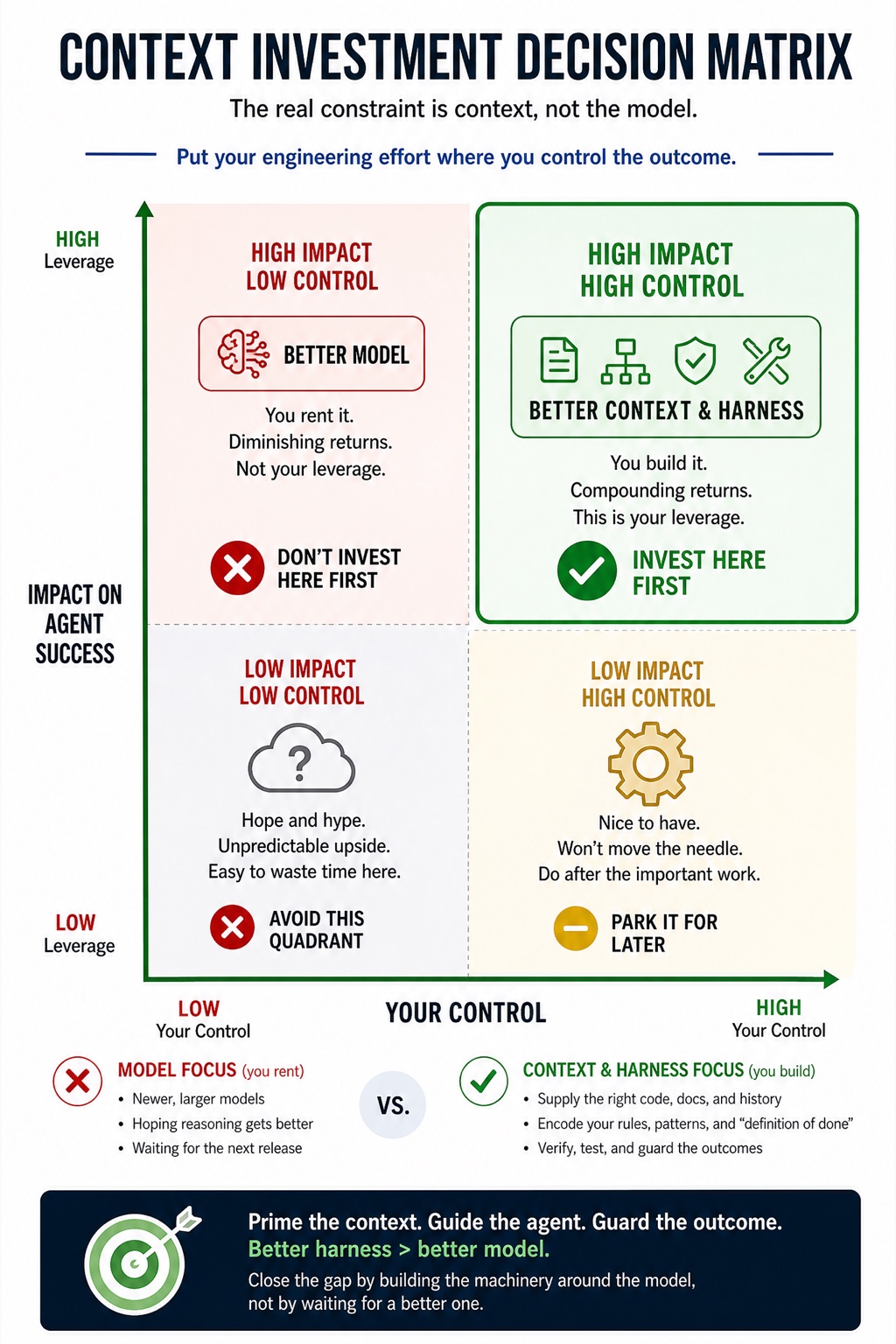
EPUB, PDF, and HTML are included so the book can work on an e-reader, as a designed copy, or as a searchable desk reference.
For e-readers and reading apps.
The designed edition with diagrams and layouts intact.
Searchable, copy-pasteable, and practical as a reference.
Yes. You get the complete edition, including the chapter sequence and internal materials described on this page.
EPUB, PDF, and HTML are included so you can read on an e-reader, keep a designed copy, or use the searchable browser version.
Because this is an instant digital download, broad change-of-mind refunds are not offered after the files have been accessed. Refund requests are reviewed within 7 days for duplicate purchases, accidental purchases before access, access failures we cannot fix, wrong files, corrupted files, or pages that materially misdescribe the book.