What a "context window" actually means
You'll know exactly how much you can hand the tool at once, and size a mixed pile — journal articles, a couple of book chapters, a long government report — before you load it.
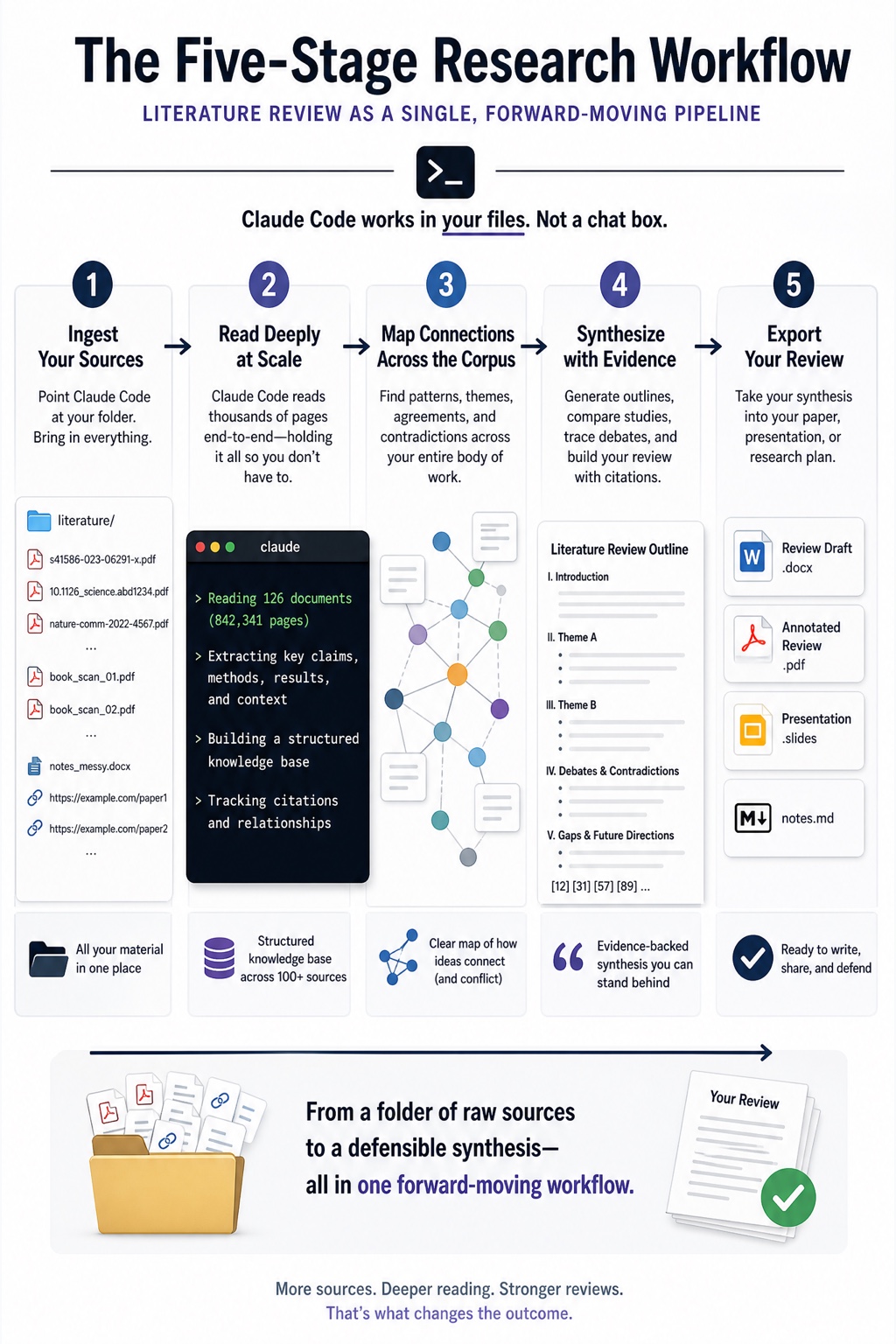
Use Claude Code's 1M-token context to analyze papers, trace connections across 100+ books, and move through your literature review faster.

Picture your literature folder right now: forty PDFs with names like s41586-023-06291-x.pdf, a few book scans, a messy notes document, and three browser tabs you've meant to read for a month.
Picture the stack you started with: forty PDFs in a downloads folder, three books you meant to finish, a citation manager full of papers you saved but never opened. The old fear was that you'd never get through it — and that's the fear this book settles.
You'll know exactly how much you can hand the tool at once, and size a mixed pile — journal articles, a couple of book chapters, a long government report — before you load it.
You'll read any convincing paper with a sharper eye, separating the claims you've actually checked from the ones you took on the author's word because the writing was confident and the journal reputable.
You'll stop ending a review with source-by-source notes whose connections live only in your head and then fade. Instead you'll read across the whole corpus and see where papers agree and disagree.
You'll turn a folder of forty PDFs and a vague deadline into a repeatable sequence — one you can rerun on the next project instead of rebuilding from memory, and that answers your advisor's "Where did this claim come from?".
You should be able to answer each in a sentence or two: Can you explain the difference between asking the tool to summarize a source and asking it to help you read deeper? Can you name two reasons a researcher with forty PDFs would reach for Claude Code instead of a browser chatbot?
Score your job against each criterion; the more you can answer "yes," the safer a single whole-corpus read becomes. One test: your estimate sits well below a million tokens, leaving room for instructions and the reply.
Starting a focused review with 22 journal articles (~20 pages each), a 90-page government report, a 40-page scanned book chapter, and 6 pages of your own notes? Estimate first: the articles alone run about 22 × 20,000 ≈ 440,000 tokens.
EPUB, PDF, and HTML are included so the book can work on an e-reader, as a designed copy, or as a searchable desk reference.
For e-readers and reading apps.
The designed edition with diagrams and layouts intact.
Searchable, copy-pasteable, and practical as a reference.
Yes. You get the complete edition, including the chapter sequence and internal materials described on this page.
EPUB, PDF, and HTML are included so you can read on an e-reader, keep a designed copy, or use the searchable browser version.
Because this is an instant digital download, broad change-of-mind refunds are not offered after the files have been accessed. Refund requests are reviewed within 7 days for duplicate purchases, accidental purchases before access, access failures we cannot fix, wrong files, corrupted files, or pages that materially misdescribe the book.