Encode the decisions you'd otherwise repeat
You capture the decisions behind a task—like extracting a payment-handling function into its own module—so the agent reuses them instead of making you repeat yourself.
Feed agents your codebase, docs, and rules so they stop guessing and start writing code that fits your project.
You diagnose why capable coding agents still invent variable names, ignore conventions, and drift mid-task as their context windows fill. You map the failure modes—context rot, the "dumb zone," and overconfident wrong answers—against your own recent sessions and pinpoint where missing context, not a weak prompt, caused the miss.
You end up with a collection of working parts: a rules file the agent reads on every task, a checklist for assembling the right files, triggers for when to compress or reset a window, isolation patterns for splitting work across sub-agents, and a governance charter so your team shares one standard. Each part works on its own.
You capture the decisions behind a task—like extracting a payment-handling function into its own module—so the agent reuses them instead of making you repeat yourself.
You feed the agent only the single validator that owns a check when you tighten one validation rule, instead of letting it pull in half the forms/ directory—three form classes, a serializer, two utility modules, and a batch of tests.
You split one agent's three jobs—understand the payment module, refactor it, write tests—so the window isn't crammed with dead-end files, a stack trace, and two abandoned approaches by the time it reaches the test code.
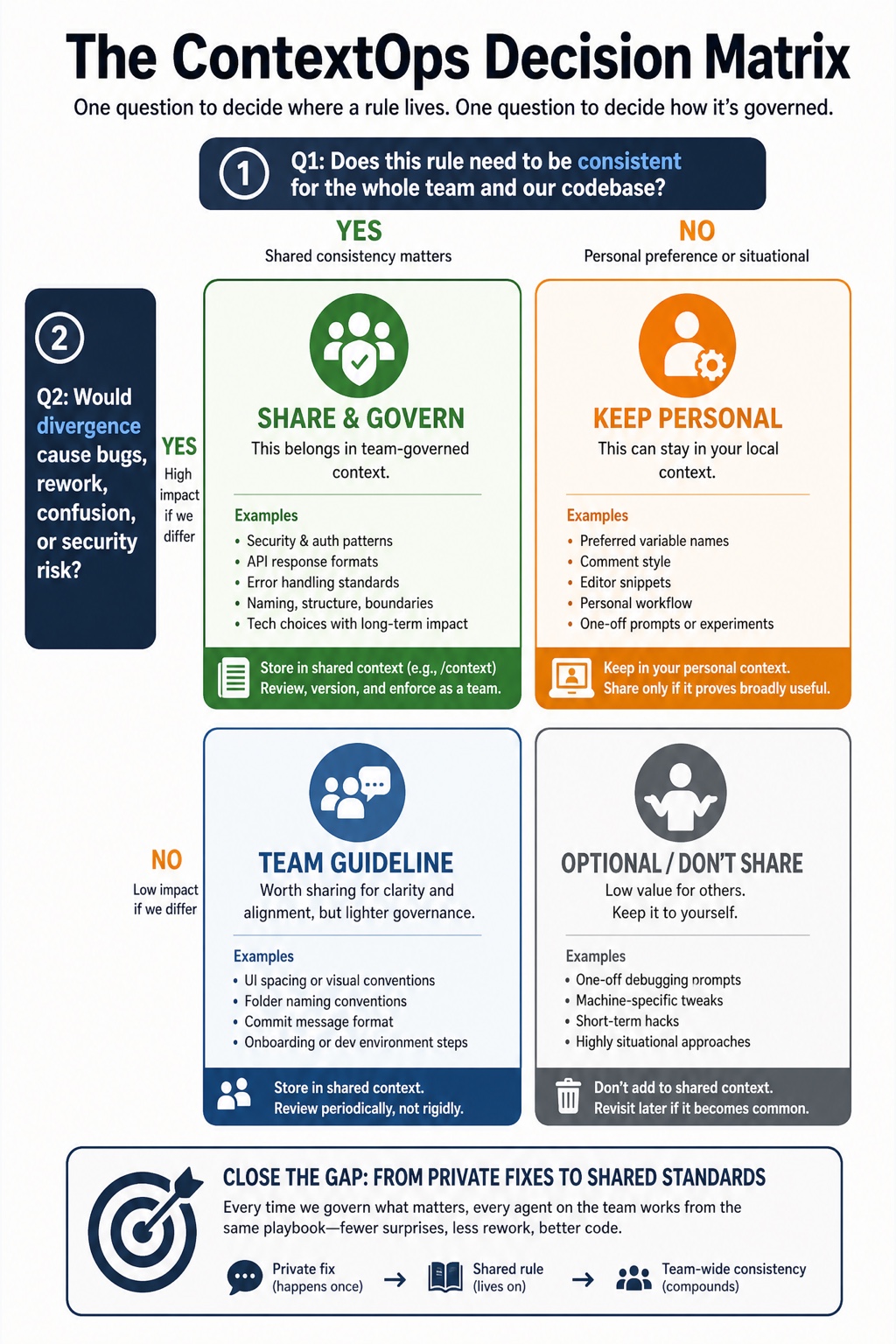
You turn the private prompt fixes buried in your team's chat—the one that "finally got the agent to stop touching the auth module"—into a shared standard instead of scattered one-off messages.
You pull your three most recent agent sessions that produced output you had to correct and fill in the autopsy worksheet for each: the task you asked for, what the agent produced, what was wrong with it, and the missing knowledge—what did the agent assume?
Before you rewrite a single instruction, you classify the failure. If the agent did exactly what you said but you said the wrong thing, that's a prompt miss—fix the wording. If it did something reasonable for a project it couldn't see, that's a context miss—fix the supply. Most failures in a mature codebase are context misses.
You open your most recent session where the output missed and ask what the agent didn't know that a competent new hire would have looked up. Say you asked it to add a field to an API response, and it returned working code that placed validation logic inline in the route handler.
You pick a single task you'll actually give an agent this week—a bug fix, a small feature, a refactor—and before writing the prompt, score your current default approach on each lever from 0 to 3, where 0 means "I do nothing here" and 3 means "I do this deliberately every time.".
You ask an agent to add rate limiting to an existing API endpoint, then run it two ways. In Window A you spend four minutes wording the request: role framing, a request to "follow best practices," and an example of clean rate-limiting code from a blog.
EPUB, PDF, and HTML are included so the book can work on an e-reader, as a designed copy, or as a searchable desk reference.
For e-readers and reading apps.
The designed edition with diagrams and layouts intact.
Searchable, copy-pasteable, and practical as a reference.
Yes. You get the complete edition, including the chapter sequence and internal materials described on this page.
EPUB, PDF, and HTML are included so you can read on an e-reader, keep a designed copy, or use the searchable browser version.
Because this is an instant digital download, broad change-of-mind refunds are not offered after the files have been accessed. Refund requests are reviewed within 7 days for duplicate purchases, accidental purchases before access, access failures we cannot fix, wrong files, corrupted files, or pages that materially misdescribe the book.