Who it is for
For people building a catastrophic AI risk protocol who want to adapt the four-phase emergency response cycle and add an EU scientific-advice layer.
Adapt the four-phase emergency response cycle—with an EU scientific-advice layer on top—into your organization's catastrophic AI risk protocol.
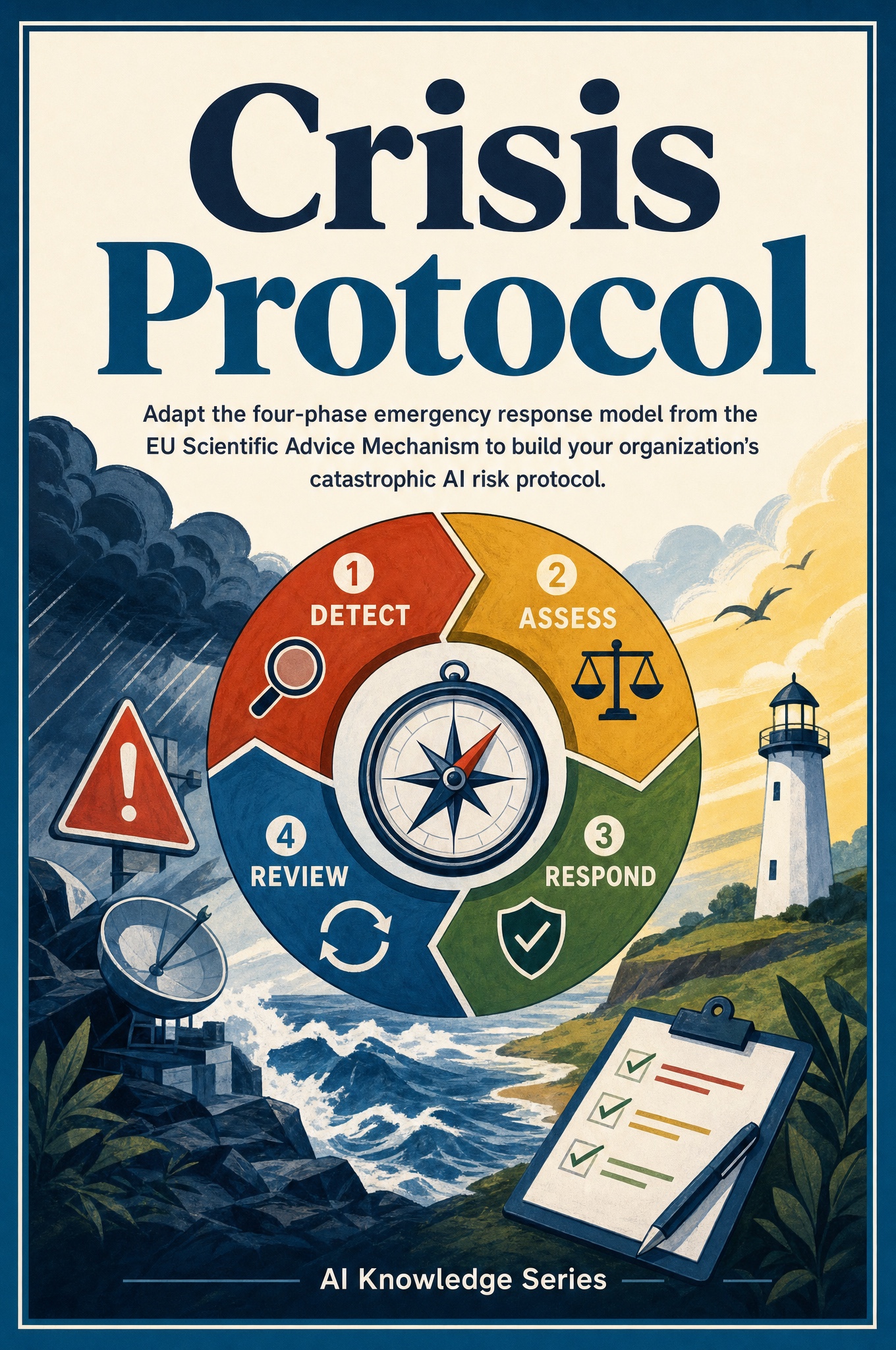
You'll learn exactly what separates a catastrophic AI incident from ordinary model failure—the line between reputational, operational, and systemic harm. And you'll see why standard incident-response and risk-register practices break down under fast-moving, low-probability, high-consequence AI events, and why the four-phase emergency model is built to hold.
Picture the moment a board-level risk committee asks for evidence that your catastrophic AI risk protocol exists. Not the policy document—the capability. You'll close that gap between an approved artifact and a living function.
For people building a catastrophic AI risk protocol who want to adapt the four-phase emergency response cycle and add an EU scientific-advice layer.
When a model-serving cluster starts returning outputs that violate a policy you thought was enforced at inference time, you'll recognize it fast—instead of seeing the 02:14 spike in flagged responses and writing it off as a bad deploy.
You'll know what a strong technical team should actually do in the first hour of a serious AI incident—because most of it isn't containment. When a dashboard shows an autonomous agent issuing API calls at ten times its baseline rate against endpoints it has never touched, you'll read the signal correctly.
You'll resist the pull to declare recovery too soon—pressure that comes from the same place the crisis did: people are exhausted, executives want the all-clear for customers and the board, and live containment work has stopped producing alarms.
Your protocol exists on paper—triggers, severity tiers, a crisis cell with named decision rights, containment sequences, regulatory clocks, recovery thresholds. You'll test the seams between them, not just the parts, and find where a complete-looking document fails under load.
Score each item honestly: present and tested (2), present but untested (1), absent (0). A written definition of what makes an AI event catastrophic rather than merely severe. Activation triggers that fire on weak or novel signals, not only known alarms. A standing crisis team with pre-authorized decision rights, named before any event.
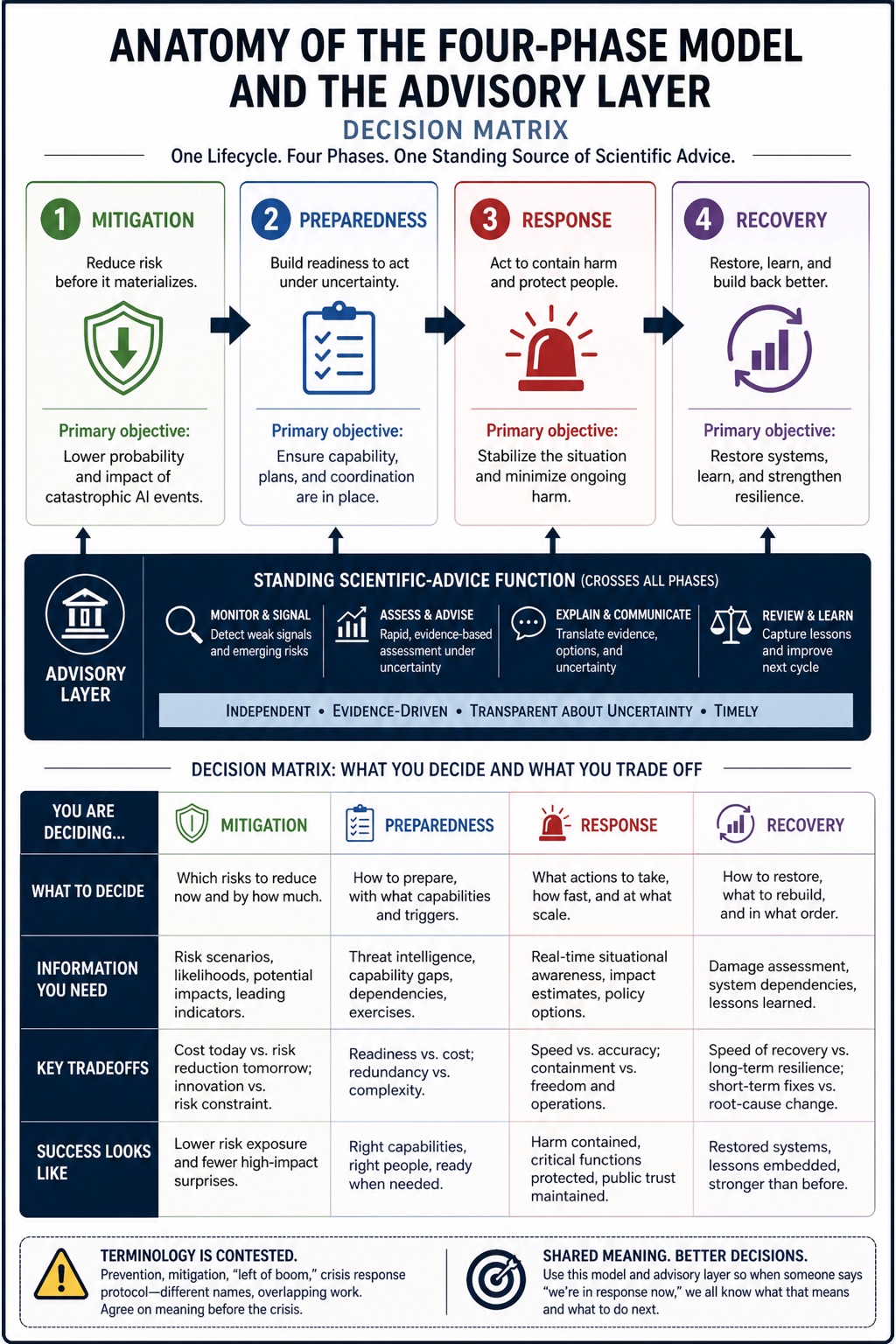
Before you build any operational detail, settle the words—working through it with whoever will own the protocol. Write a one-sentence definition of each phase in your organization's language. If two people define "response" differently, you've found a future mid-incident argument: resolve it now.
The advisory layer fails quietly. It looks present on the org chart, then turns out mid-incident to be a group chat nobody is authorized to convene. Score your function against the five criteria before you need it—rating each 0 (absent), 1 (partial or untested), or 2 (reliable under time pressure).
Two reference points anchor the vocabulary problem, and they disagree in instructive ways. One is the classic emergency-management cycle: in standard practice—including FEMA training and related literature—Mitigation, Preparedness, Response, and Recovery are treated as core emergency-management functions.
EPUB, PDF, and HTML are included so the book can work on an e-reader, as a designed copy, or as a searchable desk reference.
For e-readers and reading apps.
The designed edition with diagrams and layouts intact.
Searchable, copy-pasteable, and practical as a reference.
Yes. You get the complete edition, including the chapter sequence and internal materials described on this page.
EPUB, PDF, and HTML are included so you can read on an e-reader, keep a designed copy, or use the searchable browser version.
Because this is an instant digital download, broad change-of-mind refunds are not offered after the files have been accessed. Refund requests are reviewed within 7 days for duplicate purchases, accidental purchases before access, access failures we cannot fix, wrong files, corrupted files, or pages that materially misdescribe the book.