AI Knowledge Series / intermediate

Hermes for Content Pipelines

Build scheduled briefings, content drafts, and social posts with Hermes Agent's autonomous content creation.
9 chaptersEPUB + PDF + HTMLintermediate guide pricingDRM-free files
Hermes for Content Pipelines book cover
The problem

It starts with the situation you're actually in.

Hermes Agent is an open-source, MIT-licensed autonomous agent from Nous Research that runs unattended across messaging platforms, persists memory, and generates reusable skills. You learn to separate its verified capabilities from the marketing claims.

You have a full stack of worksheets behind you: a capability inventory, a setup checklist, a permissions worksheet, two skill prompts, a briefing pipeline, a style brief, a repurposing skill, a scheduling worksheet, a review-gate map, an integration map, and a maintenance schedule. Each one solved a piece.
Outcomes

What you'll be able to do.

The anatomy of a reusable skill

You type a request into Slack — "pull the three biggest AI policy stories this week and summarize each in two sentences" — and Hermes delivers something useful, unattended.

The gap between a good briefing and a finished draft

You approve a briefing, then turn it into a finished draft instead of stalling at "now what?".

The four failures, named

An agent that drafts, repurposes, and schedules without you watching is fast. The same loop that turns one approved draft into nine posts will, if a fact slips through, publish one error nine times before you finish your coffee — so you learn to catch it.

A connection is a dependency, and dependencies fail

You keep your pipeline running by understanding the unglamorous reason it usually works — and the dependencies that quietly break it.

Inside the book

A closer look at the work inside.

Build Your One-Page Pipeline Inventory

The artifact you carry through the whole book. List every step you currently perform to go from raw input to published content — one line each — then judge each one. Work the prompts in order.

What Hermes Is, Stated Plainly checklist

  • The briefing assembles on a fixed cadence from a defined source list and lands in your channel each morning.
  • An approved briefing flows into a first draft in your house style.
  • The draft is reshaped into platform-specific posts automatically.
  • You review and approve at two checkpoints; everything else runs without you.

The permissions worksheet

The load-bearing artifact. For every capability, set the agent's level before connecting it to anything live: No (cannot do it), Ask (must get your approval each time), or Auto (may act alone). Until you trust a step, Ask is the right default for anything that reaches an audience.

Workspace ready

Run this before any chapter-4 briefing touches a real source.
  • Build installed, host machine chosen.
  • Model selected for drafting and for routine work, spend ceiling set.
  • Exactly one platform connected, in a dedicated low-risk space.
  • Test message sent and a response confirmed.
  • Memory scope written: remember / never-store / review cadence.
  • Permissions worksheet completed, "Send" set to Ask.
  • Both worksheets saved alongside your another chapter inventory.

Trust is a configuration, not a feeling checklist

  • Trust comes from explicit configuration — where the agent runs, which model powers it, and what it may touch — not from a good demo.
  • Install one build, choose models deliberately by task and cost, and verify current pricing with the provider before committing.
  • Connect a single low-risk platform first so mistakes are cheap and visible.
  • Scope memory before it accumulates and never let it store secrets or private data.
  • The permissions worksheet is your contract with the agent; keep audience-facing sending at Ask until you build review gates later in the guide, where these boundaries get their.
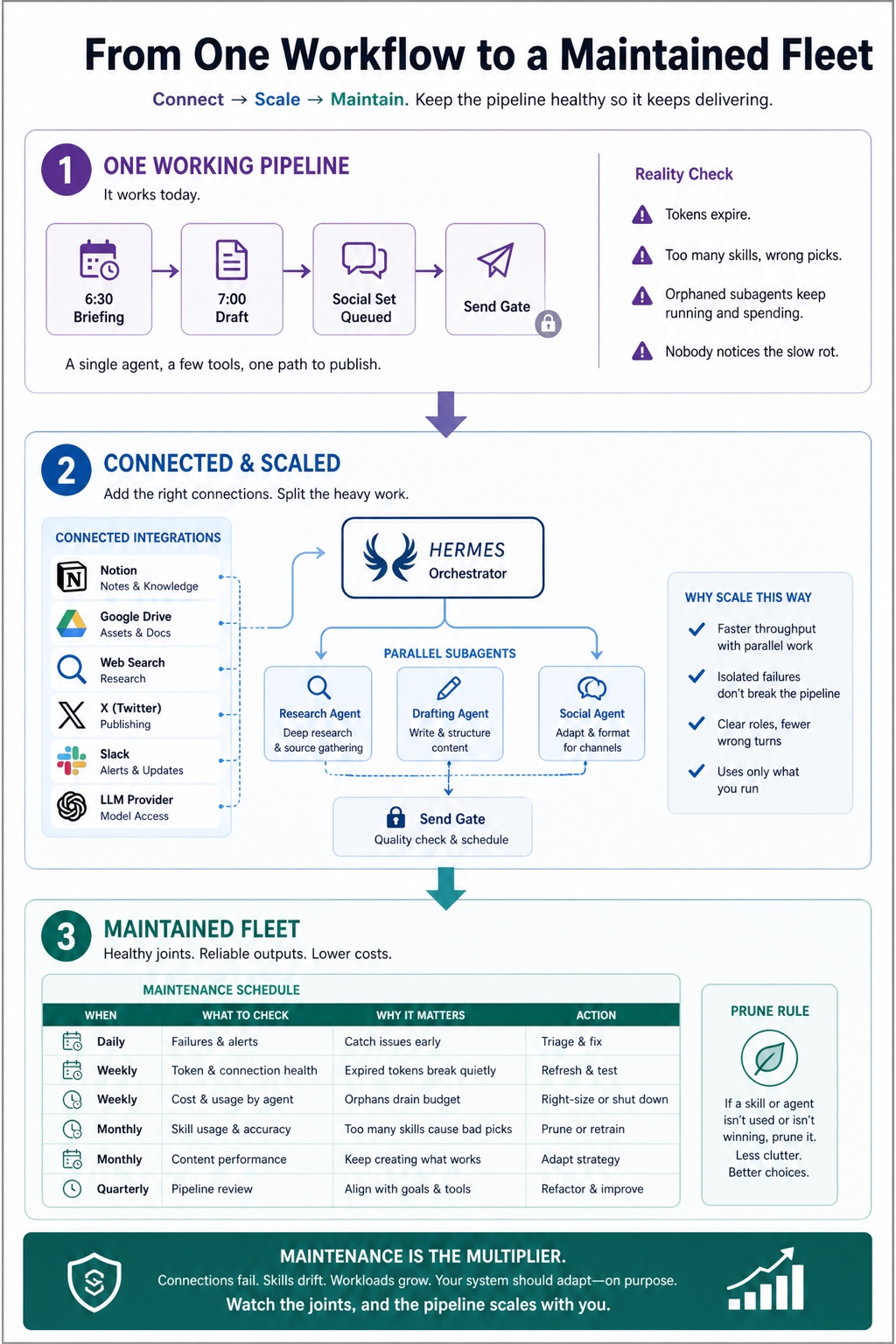
Hermes for Content Pipelines visual framework
The permissions worksheetInside the book
Visual preview

A diagram you can keep open while you work.

Table of contents

9 chapters, built to be read in order.

01

What Hermes Actually Does for a Content Pipeline

02

Setting Up a Trustworthy Workspace

03

Writing Prompts and Skills the Agent Can Reuse

04

Building Scheduled Briefings That Run Without You

05

Turning Briefings into Content Drafts

06

Producing and Scheduling Social Posts

07

Quality Control, Review Gates, and Safety

08

Connecting, Maintaining, and Scaling the Pipeline

09

Your Running Content Pipeline

160
Pages
13,209
Words
60
Exercises, checklists & tools
9
Chapters
Formats

Three formats. One purchase.

EPUB, PDF, and HTML are included so the book can work on an e-reader, as a designed copy, or as a searchable desk reference.

EPUB

For e-readers and reading apps.

PDF

The designed edition with diagrams and layouts intact.

HTML

Searchable, copy-pasteable, and practical as a reference.

Complete guide

Hermes for Content Pipelines

$9.99
intermediate guide pricing
  • EPUB + PDF + HTML included in one purchase
  • 9 chapters from the complete guide
  • DRM-free files for your own devices
  • 7-day refund review for duplicate purchases, access issues, wrong files, or materially defective downloads
Add to cart - $9.99
Secure checkout / instant download / tax handled at checkout
Before you buy

Questions, answered.

Does this include the full book?

Yes. You get the complete edition, including the chapter sequence and internal materials described on this page.

Which formats are included?

EPUB, PDF, and HTML are included so you can read on an e-reader, keep a designed copy, or use the searchable browser version.

What is the refund policy?

Because this is an instant digital download, broad change-of-mind refunds are not offered after the files have been accessed. Refund requests are reviewed within 7 days for duplicate purchases, accidental purchases before access, access failures we cannot fix, wrong files, corrupted files, or pages that materially misdescribe the book.