Who it is for
For people who want AI to give them clearer, more useful answers — no code, just better questions.
Talk to AI so it gives you clearer, more useful answers. No code, just better questions.
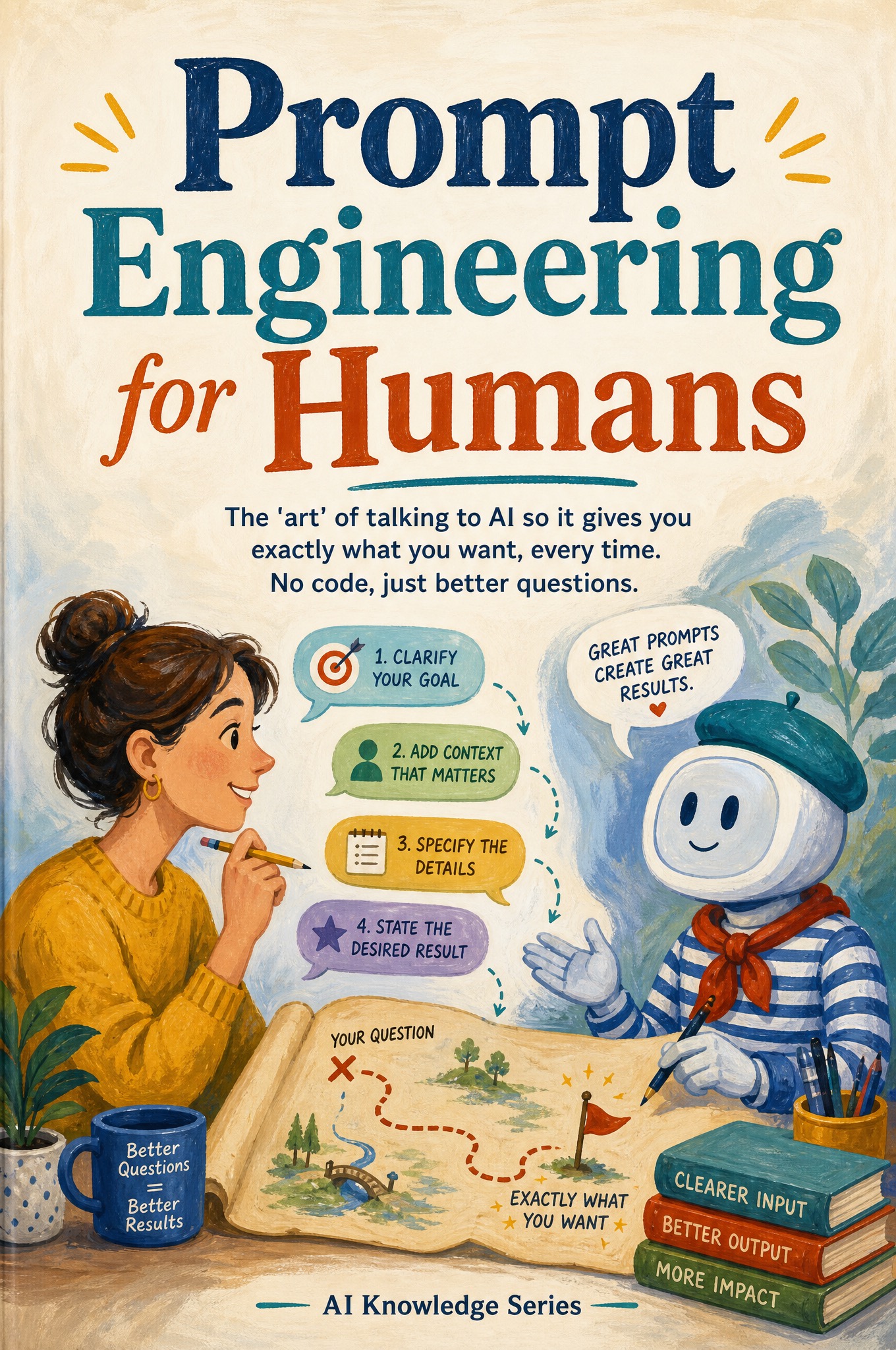
Most people who complain that AI "doesn't work" are using the same tools as the people who find it indispensable. The difference isn't a better model, a paid subscription, or technical training.
You know how the model reads your input, what the parts of a prompt are, which techniques sharpen its reasoning, and how to apply all of it to the tasks on your actual desk. The temptation now is to file it away and hope the knowledge sticks.
For people who want AI to give them clearer, more useful answers — no code, just better questions.
You'll see why the model returns something polished, professional, and completely hollow — standard responsibilities and vague qualifications that fit any company and any role, reflecting nothing about the specific team, seniority level, or person you actually need.
You'll learn the five parts of a strong prompt, then look at anything you've sent an AI in the last week and see exactly what it was missing.
You'll take techniques learned through clean examples and tidy, one-principle-at-a-time scenarios and apply them where it counts — turning AI answers that were never quite right into ones you can use.
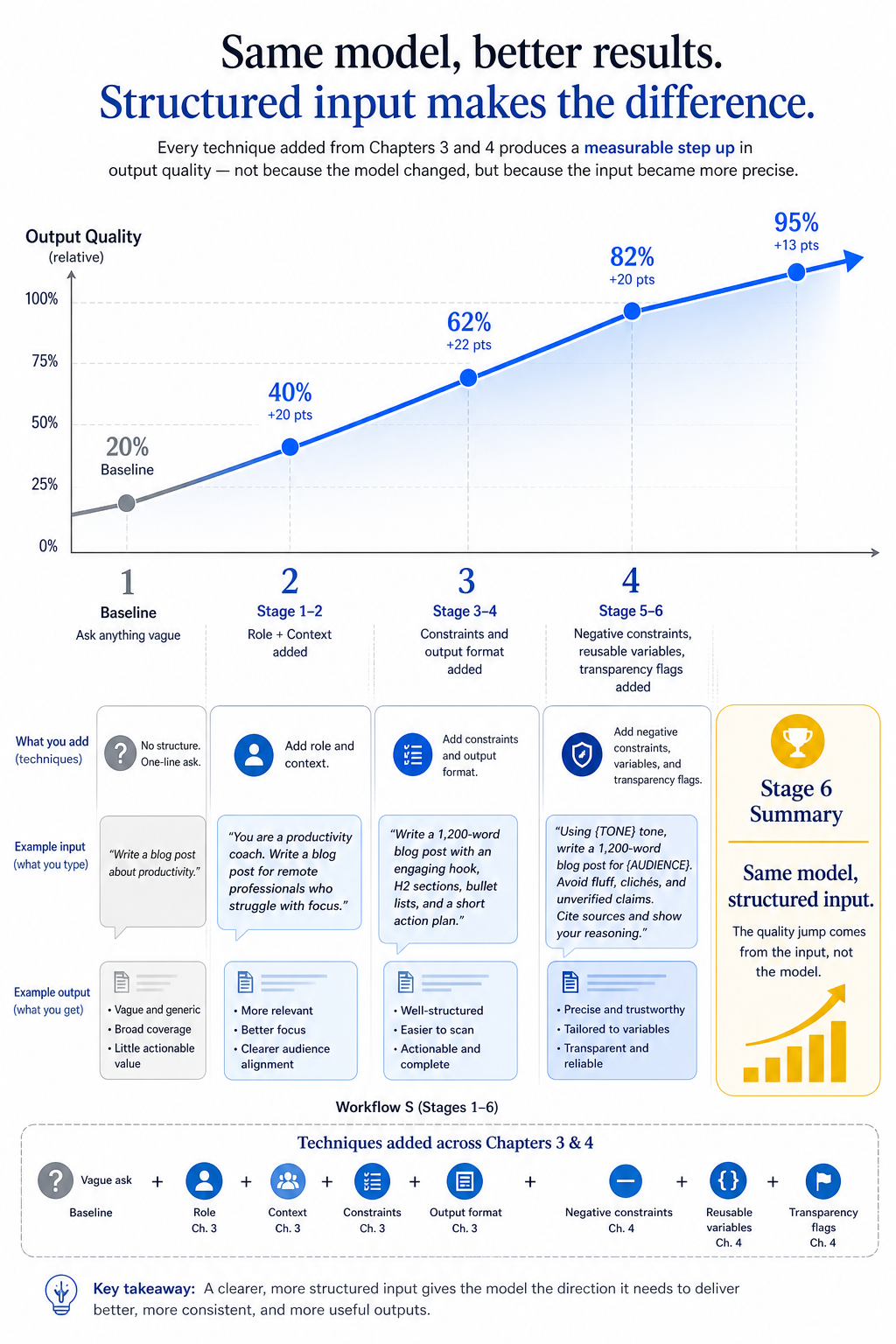
You'll build a well-structured prompt — role, task, context, constraints, output format — and still get something that's almost right but not quite, with the tone off. You'll learn three techniques that close that gap.
Before you rewrite a prompt, run it through these four questions. If you answer "no" or "I'm not sure" to any of them, you've found your problem.
Compare two requests. "Write me a cover letter" produces a mediocre result. "Write a cover letter for a marketing coordinator role at a mid-sized e-commerce company; I have three years managing social media campaigns and email newsletters" produces something you can use.
When you send a message, the model processes everything you've included — your prompt, your examples, your background information. That collection of text is the context window: the total information available to the model as it generates a response.
Not every part of your prompt carries equal weight. Instructions placed near the beginning set the interpretive frame for everything that follows; open with a role or context statement and the model holds that lens as it weighs the rest of your request.
The model's context window is blank at the start of every conversation. Context is how you fill it with the background information that changes what the model produces — and good context is not a data dump.
EPUB, PDF, and HTML are included so the book can work on an e-reader, as a designed copy, or as a searchable desk reference.
For e-readers and reading apps.
The designed edition with diagrams and layouts intact.
Searchable, copy-pasteable, and practical as a reference.
Yes. You get the complete edition, including the chapter sequence and internal materials described on this page.
EPUB, PDF, and HTML are included so you can read on an e-reader, keep a designed copy, or use the searchable browser version.
Because this is an instant digital download, broad change-of-mind refunds are not offered after the files have been accessed. Refund requests are reviewed within 7 days for duplicate purchases, accidental purchases before access, access failures we cannot fix, wrong files, corrupted files, or pages that materially misdescribe the book.