Agentic AI Coding / Beginner

Prompting for Code

Give your coding agent instructions it can actually build from — and get working software instead of confident nonsense.

6 chaptersEPUB + PDF + HTMLBeginner guide pricingDRM-free files
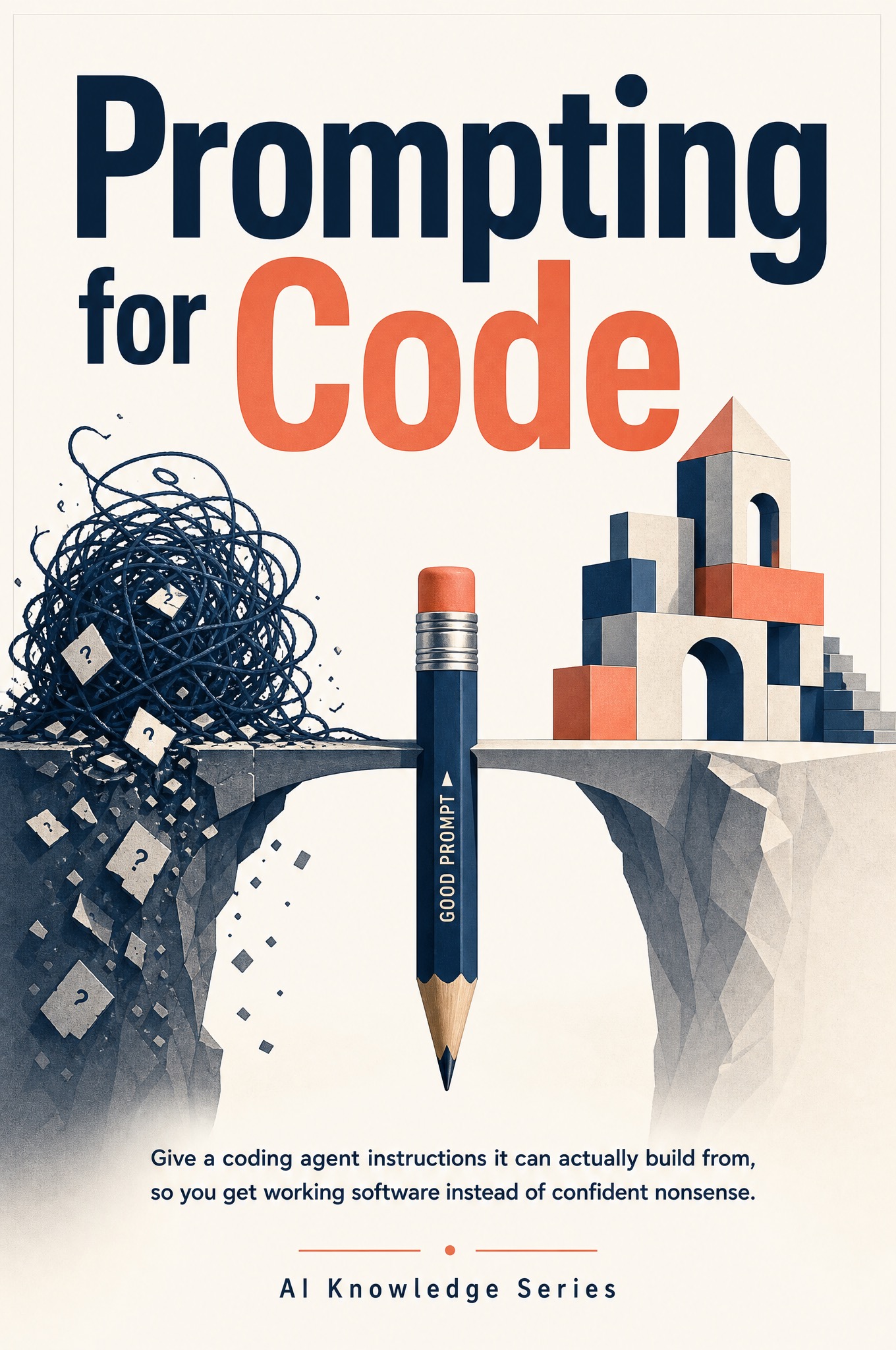
Prompting for Code book cover
The problem

It starts with the situation you're actually in.

You type a request into a coding tool, hit enter, and watch it work for forty seconds. It edits three files, runs a command, and reports success in a confident paragraph — that may or may not match what you wanted. This is about closing that gap.

You can write prompts with four parts. You can feed the agent the right context and starve it of noise. Now picture the next real task on your list and how differently it goes.
Outcomes

What you'll be able to do.

Start With the Thing That Goes Wrong

You ask for "a login form" and get a new page, a form library you don't use, a fake authentication call, and inline CSS that clashes with everything. You learn to start from what goes wrong, so the agent builds what you actually meant.

The Two Ways Context Fails

You have a 40-file project and one request: "Add a logout button to the header." To be safe, you paste App.jsx, the routing file, your auth helper, the API client, and the nav CSS — and you learn why too much context fails as badly as too little.

The Summary Is Not the Change

The agent hands back a diff: twelve files changed, a new helper, a couple of tests, and a cheerful note that everything is "working as expected." You learn to read the change itself instead of trusting the summary.

Each Job Answers a Different Question

On a real project you usually want one of three things from the agent: a small new feature, a fix for a bug you can name, or tests that prove the code does what you claim. You learn to prompt each one for the question it actually answers.
Inside the book

A closer look at the work inside.

The Same Request, Two Readings

You tell the agent, "Fix the date so it shows correctly." You mean the format your European users expect — day before month. The agent reads "correctly" against its own default, likely month before day, confirms the date renders without error, and reports success.

Run a Task Through the Four Blocks

Take a real or imagined task and run it through the four blocks before anything fancy: write the goal in one sentence; if it says "better," "clean up," or "improve," rewrite it with a concrete result; then list the context — one file path and one pattern to follow.

The Start With the Thing That Goes Wrong Checklist

  • Goal — What outcome do you want? One clear sentence about the change, not the steps.
  • Context — What does the agent need to know to do this in your project? Files, the stack, the pattern to follow.
  • Constraints — What are the rules and boundaries? What must it not touch, change, or invent?
  • Definition of done — How will both of you know the work succeeded? The observable, checkable result.

One Prompt, Rewritten

Here's a request as a beginner often writes it: "Add some error handling to the upload feature." The agent has to guess what "error handling" means, where the upload feature lives, which errors matter, and when to stop. You watch it get rewritten into something buildable.

Context That Fits

Before you send, run the prompt through these.

  • Did I point at an existing file as the pattern to follow, where one exists?
  • Did I state the stack facts that change the code (framework, language, styling, state, tests)?
  • For every file I included, can I name why the agent needs it?
  • Did I slice large files down to the part that matters?
  • Did I mark what stays untouched?
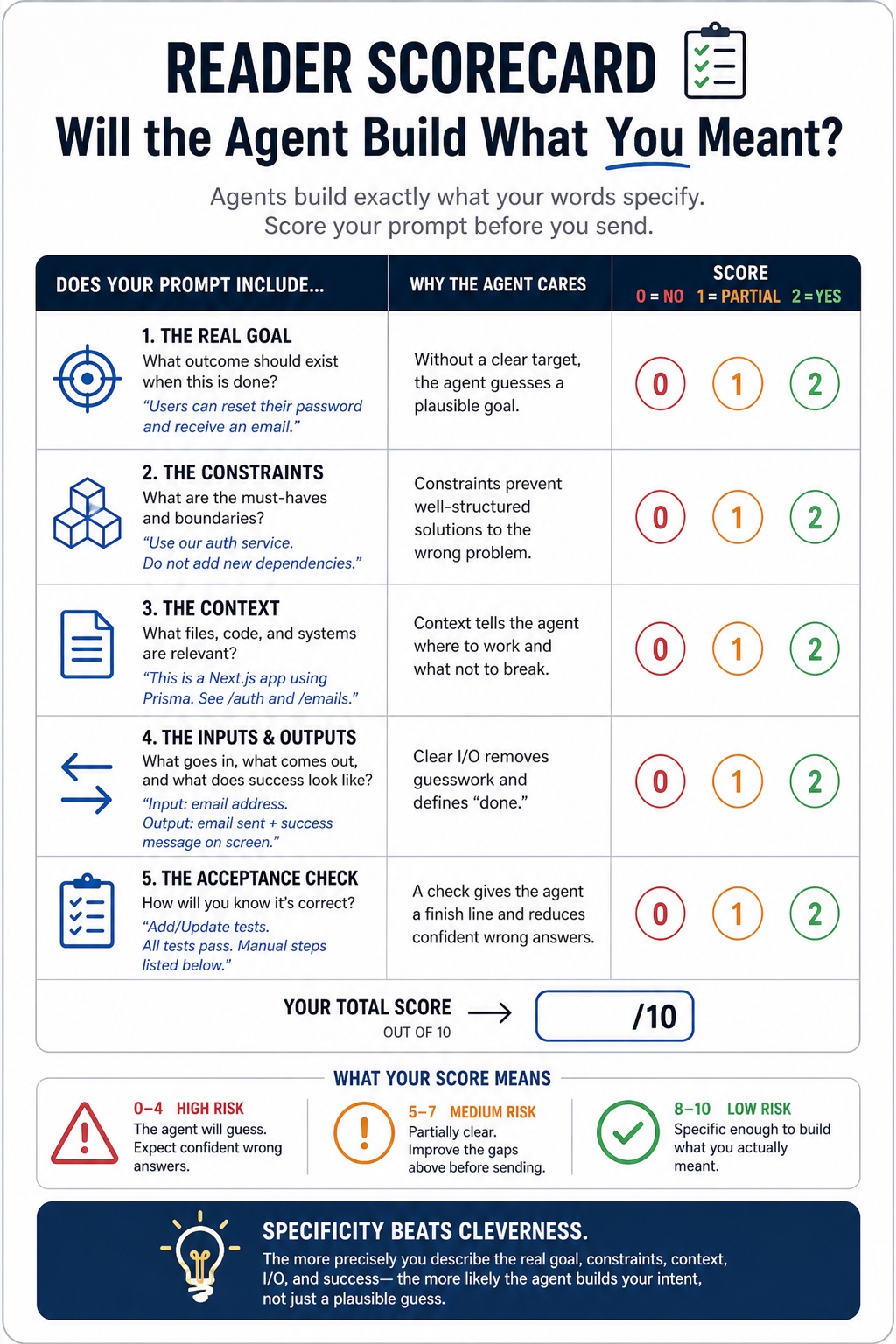
Prompting for Code visual framework
Prompting for Code frameworkInside the book
Visual preview

A diagram you can keep open while you work.

Table of contents

6 chapters, built to be read in order.

01

What a Coding Agent Actually Hears

02

The Anatomy of an Instruction the Agent Can Build From

03

Giving Context Without Drowning the Agent

04

Prompting for Common Jobs — Features, Fixes, and Tests

05

Reading the Output and Steering the Next Turn

06

From First Prompt to Working Software

134
Pages
9,356
Words
22
Exercises, checklists & tools
6
Chapters
Formats

Three formats. One purchase.

EPUB, PDF, and HTML are included so the book can work on an e-reader, as a designed copy, or as a searchable desk reference.

EPUB

For e-readers and reading apps.

PDF

The designed edition with diagrams and layouts intact.

HTML

Searchable, copy-pasteable, and practical as a reference.

Complete guide

Prompting for Code

$6.99
Beginner guide pricing
  • EPUB + PDF + HTML included in one purchase
  • 6 chapters from the complete guide
  • DRM-free files for your own devices
  • 7-day refund review for duplicate purchases, access issues, wrong files, or materially defective downloads
Add to cart - $6.99
Secure checkout / instant download / tax handled at checkout
Before you buy

Questions, answered.

Does this include the full book?

Yes. You get the complete edition, including the chapter sequence and internal materials described on this page.

Which formats are included?

EPUB, PDF, and HTML are included so you can read on an e-reader, keep a designed copy, or use the searchable browser version.

What is the refund policy?

Because this is an instant digital download, broad change-of-mind refunds are not offered after the files have been accessed. Refund requests are reviewed within 7 days for duplicate purchases, accidental purchases before access, access failures we cannot fix, wrong files, corrupted files, or pages that materially misdescribe the book.