The tell that no longer tells
You learn why the old phishing tells — bad grammar, odd spelling, stilted English — no longer protect you, now that the inbox is the cheapest, most automated way in and still where most payment approvals begin.
Stop AI-powered phishing, fake invoices, and deepfake 'CEO' calls before they drain your accounts.
Most security advice assumes you'll recognize the moment you're under attack — a clumsy phrase, a sender address that doesn't match, a request that feels off. That assumption is now broken.
You can build a baseline score, map your money trails, sharpen your phishing instincts, lock down payment changes, set challenge phrases against deepfake calls, write verification policy, and assemble a recovery runbook — but on its own, that's a lot of paper.
You learn why the old phishing tells — bad grammar, odd spelling, stilted English — no longer protect you, now that the inbox is the cheapest, most automated way in and still where most payment approvals begin.
You follow a single message all the way to the bank and find the request that drains the most from businesses: not a dramatic deepfake, but one quiet line in an email — "We've changed banks.".
You stop relying on a defense that lives only in your head and protects a single decision point — because the attacker only needs the weakest one.
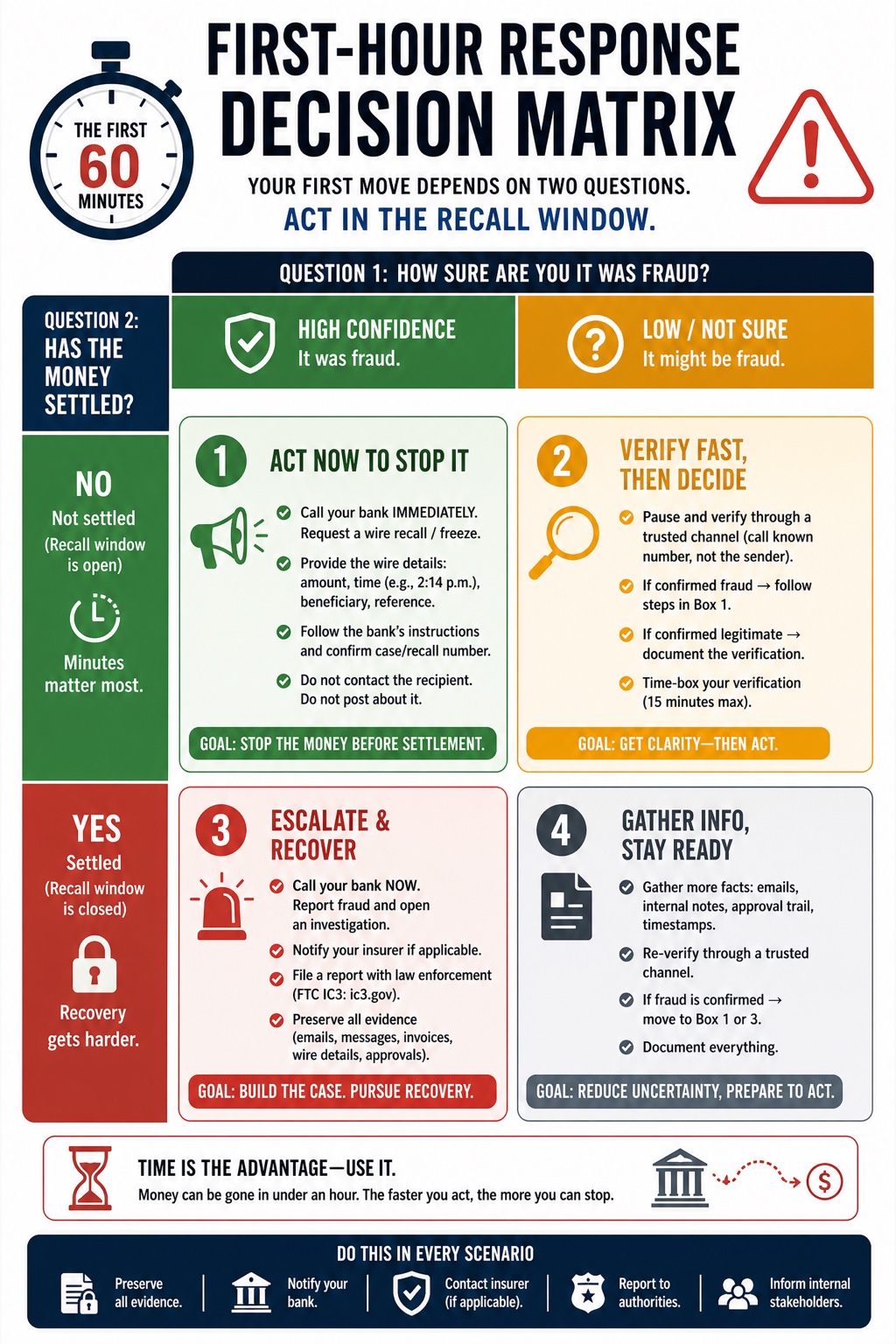
You see why the first hour decides everything: a wire leaves at 2:14 p.m., and by the time you notice, the money is already moving through a correspondent bank toward an account that will be emptied within the hour.
Measure where you stand before you build anything. Score yourself honestly on what your business actually does today — not what you intend to do later — giving yourself the points shown for each statement that is consistently true.
Prompts to fill the two-page money-trail inventory: for every way money leaves the business, record the mechanism (wire, ACH, payroll, card, platform), the maximum it can move, who can authorize it, what the approval actually depends on, and whether one person could fake or alter it.
A low-effort exercise: open your company's public footprint with one question in mind — if I wanted to impersonate someone here and request a payment, what would I now know? You'll typically find the CFO's name and voice within ten minutes, a recently announced supplier, and the rough shape of who reports to whom.
Run these on real messages from your own archive, not invented samples, to build pattern recognition on the traffic you actually receive. Drill 1 — header and address inspection: open the full sender address, not the display name, and compare the domain character by character against a known-good message from the same party.
EPUB, PDF, and HTML are included so the book can work on an e-reader, as a designed copy, or as a searchable desk reference.
For e-readers and reading apps.
The designed edition with diagrams and layouts intact.
Searchable, copy-pasteable, and practical as a reference.
Yes. You get the complete edition, including the chapter sequence and internal materials described on this page.
EPUB, PDF, and HTML are included so you can read on an e-reader, keep a designed copy, or use the searchable browser version.
Because this is an instant digital download, broad change-of-mind refunds are not offered after the files have been accessed. Refund requests are reviewed within 7 days for duplicate purchases, accidental purchases before access, access failures we cannot fix, wrong files, corrupted files, or pages that materially misdescribe the book.