Knowledge & Research / Intermediate

Talk to Your Data

Ask any spreadsheet or dashboard a question in plain English and get the chart, the answer, and the why.
9 chaptersEPUB + PDF + HTMLIntermediate guide pricingDRM-free files
Talk to Your Data book cover
The problem

It starts with the situation you're actually in.

Close the everyday gap between having data and understanding it. Natural-language analytics has shifted from novelty to a standard feature in tools like Metabase, Formula Bot, and ThoughtSpot.

You have nine columns of monthly data, a question your manager asked an hour ago, and a tool that will happily answer it three different ways depending on how you phrase the prompt. You'll know how to pull the one answer you can stand behind.
Outcomes

What you'll be able to do.

Spot the Confident Wrong Answer

A regional sales lead asks a natural-language tool, "What was our average deal size last quarter?" It returns a clean $48,200 — and you'll know whether that number can be trusted.

The Tool Answers; It Doesn't Vouch

A dashboard tells a sales team their conversion rate jumped 40% overnight, and people start congratulating each other. You'll know to check before you celebrate.

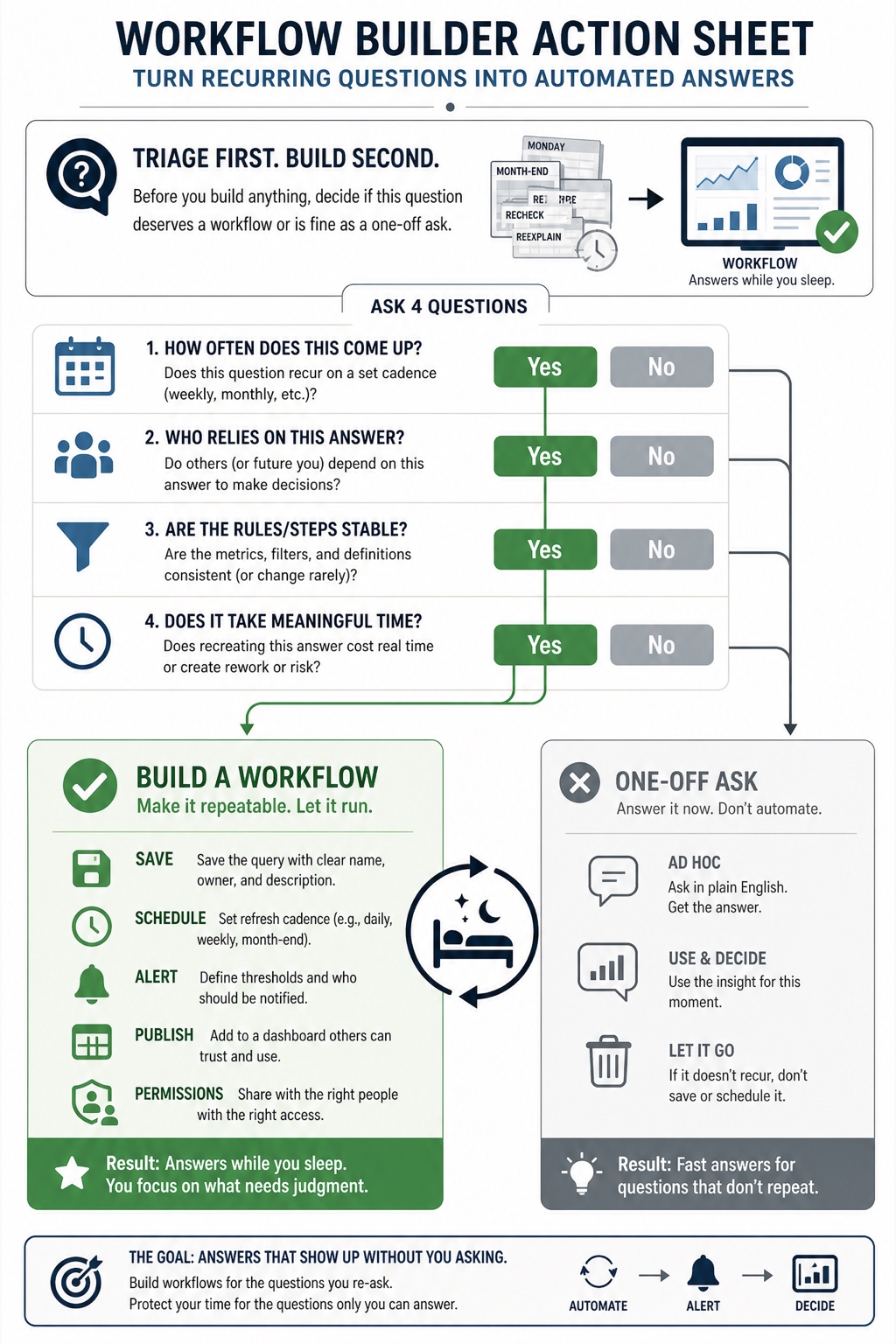
When the Same Question Keeps Coming Back

Every Monday you rebuild the same revenue-by-region view by hand. You'll turn that repeat work into something you set up once.

A Decision Needs a Sentence, Not a Dashboard

You verified the number. You found the why. Now you can say it in one line that moves the decision.

Inside the book

A closer look at the work inside.

Set Up Your Practice File

This book only works if you practice on something you care about. Pick one real, low-stakes file to carry all the way through — a sales export, a marketing spend report, a list of support tickets, a project tracker. Real enough to matter, not so sensitive that experimenting feels risky.

You Already Have the Answer. You Just Can't Reach It. checklist

  • Low Clarity scores mean another chapter (framing) is your highest-leverage stop.
  • Low Data scores point you hard later in the guide (profiling your file).
  • Low Trust scores are a another chapter problem (reading answers skeptically).
  • Low Speed scores are solved later in the guide (saved queries and dashboards).

The Framing Worksheet

Take one question you actually want answered from your practice file and run it through the worksheet. Do it in writing — the act of filling the blanks is what exposes the ones you can't yet fill.
Before You Type Anything

  • I named a single metric, not a vague outcome like "performance.".
  • I chose a segment — even if that segment is deliberately "all.".
  • I bounded a timeframe with real dates, not "lately.".
  • I stated a comparison so the answer can be judged good or bad.
  • I know whether I'm asking a descriptive, diagnostic, or predictive question.
  • I can name the decision this answer would inform.
  • I have a reasonable belief my data contains what the question needs.

When "How Are We Doing?" Gets You Nowhere checklist

  • "How are we doing?" fails because it names no metric, segment, timeframe, or comparison — so the tool guesses, and you inherit the guess.
  • Every answerable question pins down four components; the comparison is what turns a bare number into a judgment.
  • Asks come in three kinds — descriptive (what), diagnostic (why), predictive (what next) — and trouble starts when you expect descriptive certainty from a diagnostic or predictive.
  • Getting the question right before touching a tool is the highest-leverage step in the whole workflow.
  • You ran a real curiosity through the framing worksheet and scored it for specificity, answerability, and decision-link.
Talk to Your Data visual framework
The Framing WorksheetInside the book
Visual preview

A diagram you can keep open while you work.

Table of contents

9 chapters, built to be read in order.

01

From Staring at Spreadsheets to Asking Them Questions

02

The Question Behind the Question

03

Know Your Data Before You Interrogate It

04

Writing Prompts That Return the Right Chart

05

Reading the Answer With a Skeptic's Eye

06

From Chart to 'Why'—Turning Patterns Into Explanations

07

Building Repeatable Workflows and Living Dashboards

08

Communicating the Answer So Decisions Get Made

09

Your Data Conversation Practice—Putting It All Together

192
Pages
13,607
Words
43
Exercises, checklists & tools
9
Chapters
Formats

Three formats. One purchase.

EPUB, PDF, and HTML are included so the book can work on an e-reader, as a designed copy, or as a searchable desk reference.

EPUB

For e-readers and reading apps.

PDF

The designed edition with diagrams and layouts intact.

HTML

Searchable, copy-pasteable, and practical as a reference.

Complete guide

Talk to Your Data

$9.99
Intermediate guide pricing
  • EPUB + PDF + HTML included in one purchase
  • 9 chapters from the complete guide
  • DRM-free files for your own devices
  • 7-day refund review for duplicate purchases, access issues, wrong files, or materially defective downloads
Add to cart - $9.99
Secure checkout / instant download / tax handled at checkout
Before you buy

Questions, answered.

Does this include the full book?

Yes. You get the complete edition, including the chapter sequence and internal materials described on this page.

Which formats are included?

EPUB, PDF, and HTML are included so you can read on an e-reader, keep a designed copy, or use the searchable browser version.

What is the refund policy?

Because this is an instant digital download, broad change-of-mind refunds are not offered after the files have been accessed. Refund requests are reviewed within 7 days for duplicate purchases, accidental purchases before access, access failures we cannot fix, wrong files, corrupted files, or pages that materially misdescribe the book.