Who it is for
For builders wiring multiple specialized agents into one system meant to run whole slices of a business on autopilot.
Wire multiple specialized agents into one system that runs whole slices of your business on autopilot.
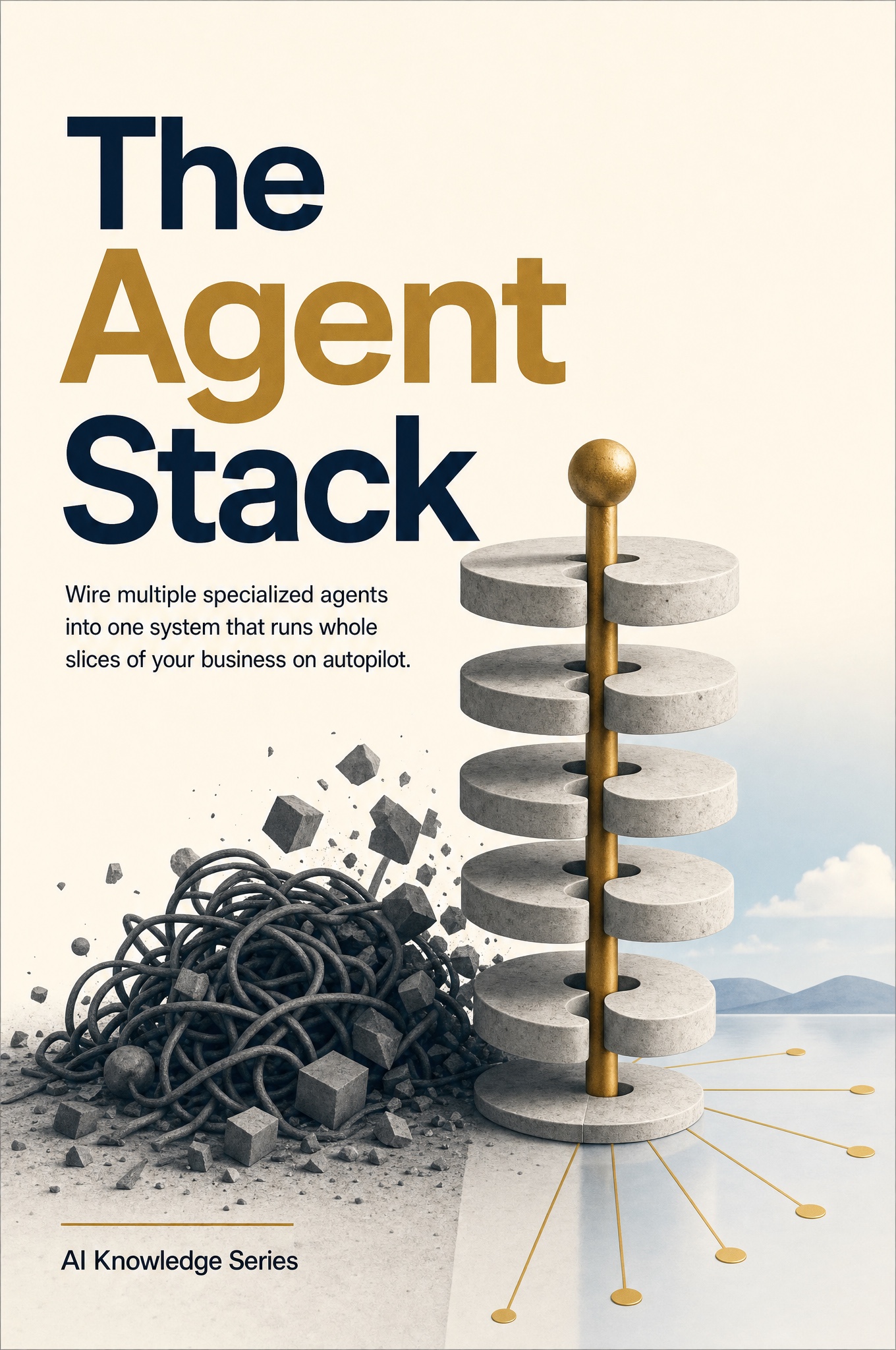
Almost every team that ships an agent into production learns the same lesson in the same order: the demo works, and then something underneath gives way. That something is the stack.
You've placed a bet on where durable advantage lives, whether you meant to or not. Most teams running agents in production wagered by default on the model. This book makes the opposite case.
For builders wiring multiple specialized agents into one system meant to run whole slices of a business on autopilot.
You trace why a single "ops" agent wired to handle refund requests runs clean for three weeks—and what's quietly building underneath that whole time.
You spot the real fault when a three-agent support system—classify, draft, escalate—emails an upgraded customer their old tier's limits days after they switched.
You learn to watch the whole chain instead of the single call—because a system where every agent answers plausibly, every tool succeeds, and every handoff completes can still be silently wrong.
You choose a first slice narrow enough to lose, so you get past the stall where the demo runs, traces are clean, evals pass—and nobody will take their hand off the wheel.
You reproduce the failure with clean, isolated inputs and confirm the model fails even then. You name which layer fed it bad input or dropped its output, price the upgrade against fixing that layer, and buy reasoning quality—not reliability you should have engineered.
Map a concrete case onto your own system: a refund agent where roughly one in twenty refunds processes twice, and a vendor pitch promising a stronger model that "understands financial context better." Before you sign, you run the diagnostic.
You gain the single most useful skill here—telling the two failure classes apart before you spend money. A model problem is a reasoning or generation failure: given correct, complete, current input, the model still produces a wrong, incoherent, or unsafe output.
You get the stack as ordered layers, each owning a class of failure. The shape converges across O'Reilly's AI Agents Stack (2026 Edition), MindStudio's six-layer infrastructure writeups, and ByteByteGo's EP218: compute and sandboxes, models, memory, tools, orchestration, and workflows.
You run a thirty-minute audit against a system you already operate. For each of the six layers—workflow, orchestration, tools, memory/data, model, compute—you NAME the component that plays the role and write the one-sentence CONTRACT with the layer above it.
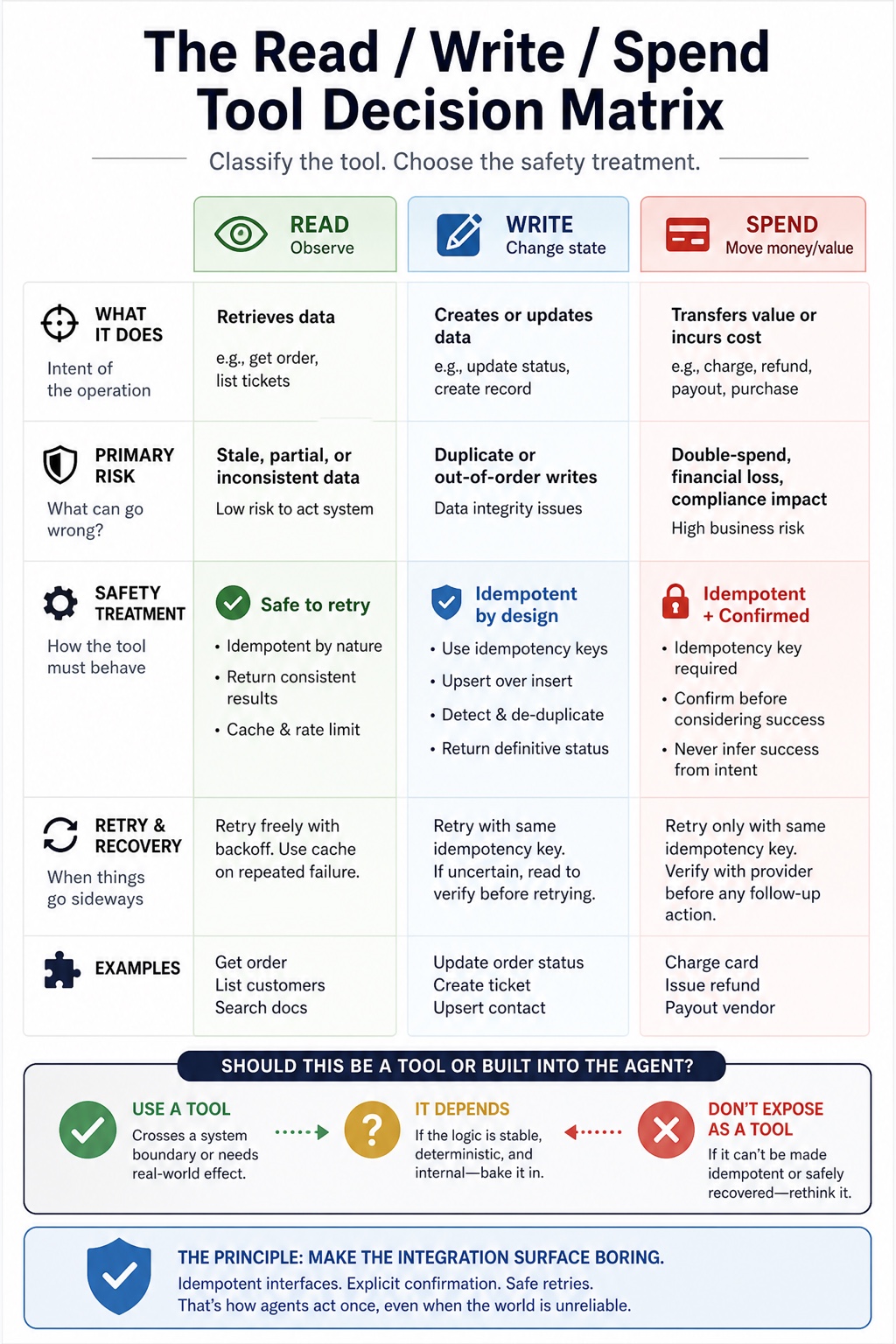
EPUB, PDF, and HTML are included so the book can work on an e-reader, as a designed copy, or as a searchable desk reference.
For e-readers and reading apps.
The designed edition with diagrams and layouts intact.
Searchable, copy-pasteable, and practical as a reference.
Yes. You get the complete edition, including the chapter sequence and internal materials described on this page.
EPUB, PDF, and HTML are included so you can read on an e-reader, keep a designed copy, or use the searchable browser version.
Because this is an instant digital download, broad change-of-mind refunds are not offered after the files have been accessed. Refund requests are reviewed within 7 days for duplicate purchases, accidental purchases before access, access failures we cannot fix, wrong files, corrupted files, or pages that materially misdescribe the book.