The Proposal That Survived the Filter
You read every proposal knowing it has already cleared several informal review stages before it reaches your desk. The team that built it believed in it enough to spend weeks developing it.
Evaluate, budget for, and govern AI across your organization—without getting sold snake oil. Written for directors and VPs.
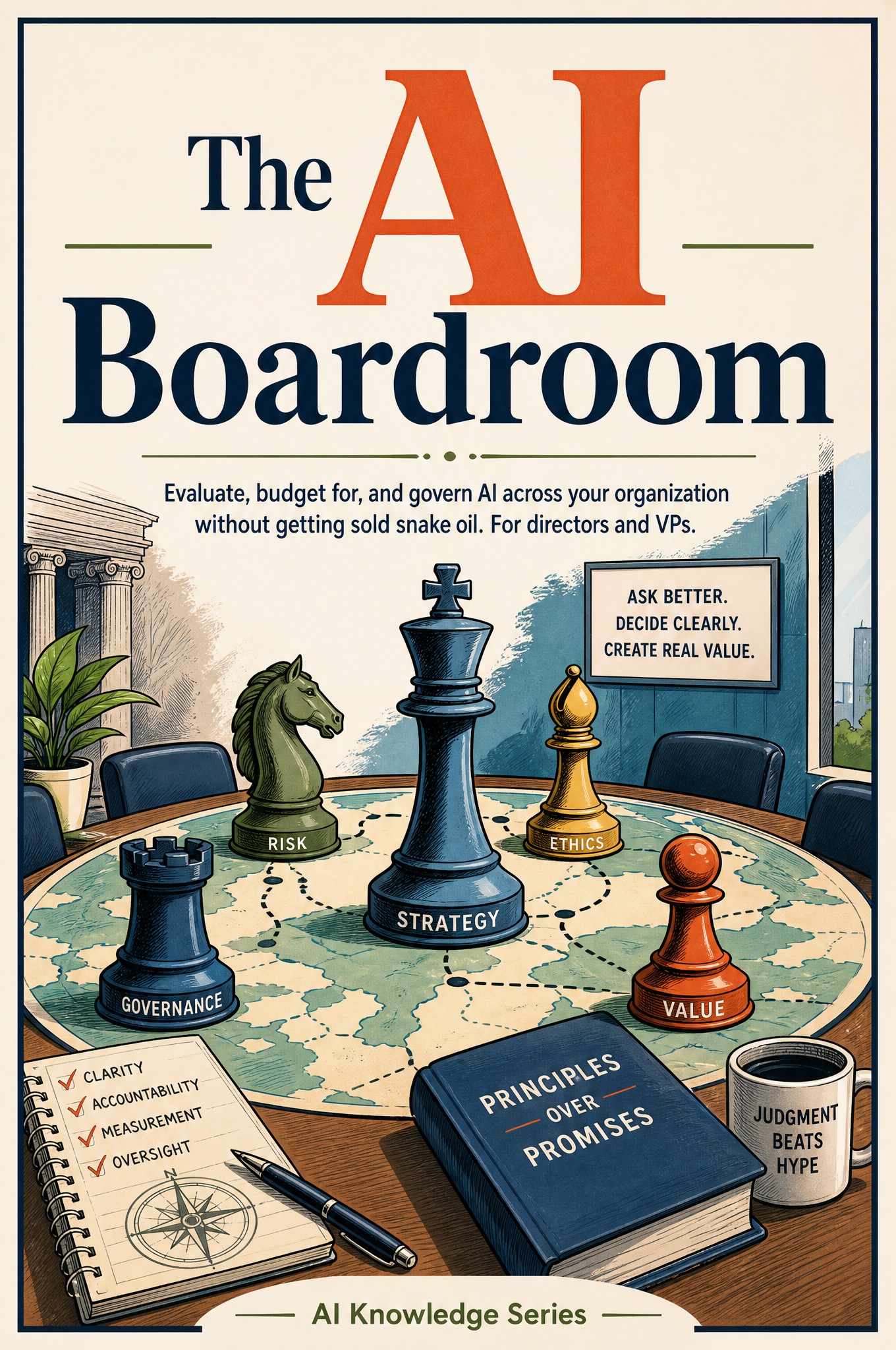
Your board is receiving AI proposals faster than it can evaluate them. Vendors have learned that "AI-powered" commands a premium and shortens procurement cycles. What you need isn't a technical education.
The next AI investment proposal will reach your board before the quarter ends. The materials will look familiar: vendor benchmarks assembled under favorable conditions, an ROI projection built on assumptions the presenting team chose, and a risk summary written by the people who want the budget approved.
You read every proposal knowing it has already cleared several informal review stages before it reaches your desk. The team that built it believed in it enough to spend weeks developing it.
You see why a flawless demo proves little. In clinical documentation AI, the demo transcribes a physician consultation in real time, catches a missed medication interaction, and produces a structured note in under thirty seconds. Clean, accurate, impressive—and not the product.
You name what a board actually approves when it greenlights AI in operations, legal, or customer service: partly a technology contract, partly a budget line, and—if the proposal is honest—a decision about people's jobs.
You spot the exposure when your board secretary runs this quarter's board pack—fourteen documents—through a cloud-based AI summarizer.
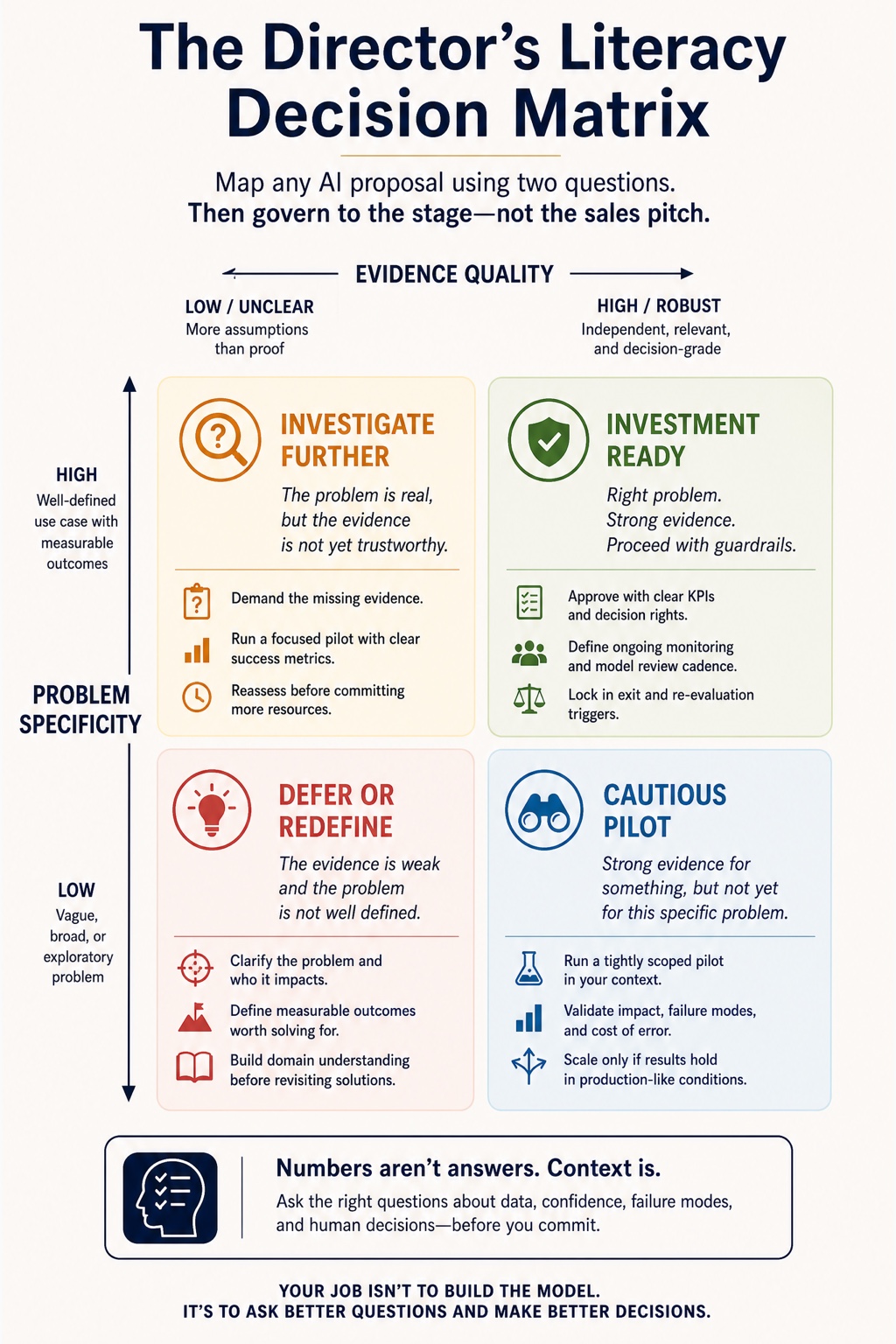
Five questions answered in writing before any AI initiative receives board or executive-committee approval. A proposal that can't satisfy all five has work left before it belongs on your agenda. First: what was the model trained on, and does that data represent your actual use case?
The build-versus-buy calculus has changed. A few years ago, a custom model was often the only path to production-grade performance on domain-specific tasks. For most use cases, that's no longer true.
You approve an AI-assisted contract review tool for legal operations: ingest contracts, flag non-standard clauses, route high-risk items to counsel. Year 1 all-in cost is $480,000—implementation, licensing, and infrastructure. Projected savings: $650,000 a year from reduced outside counsel time.
Before any AI pilot receives its initial funding, the sponsoring team completes this worksheet. File it with the original proposal and resurface it at every subsequent funding review.
EPUB, PDF, and HTML are included so the book can work on an e-reader, as a designed copy, or as a searchable desk reference.
For e-readers and reading apps.
The designed edition with diagrams and layouts intact.
Searchable, copy-pasteable, and practical as a reference.
Yes. You get the complete edition, including the chapter sequence and internal materials described on this page.
EPUB, PDF, and HTML are included so you can read on an e-reader, keep a designed copy, or use the searchable browser version.
Because this is an instant digital download, broad change-of-mind refunds are not offered after the files have been accessed. Refund requests are reviewed within 7 days for duplicate purchases, accidental purchases before access, access failures we cannot fix, wrong files, corrupted files, or pages that materially misdescribe the book.