Who it is for
For anyone who wants to use AI for journaling, reflection, and hard moments, while staying honest about what it can't replace.
Use AI for journaling, reflection, and the tough moments — with a clear-eyed guide to what it can't replace.
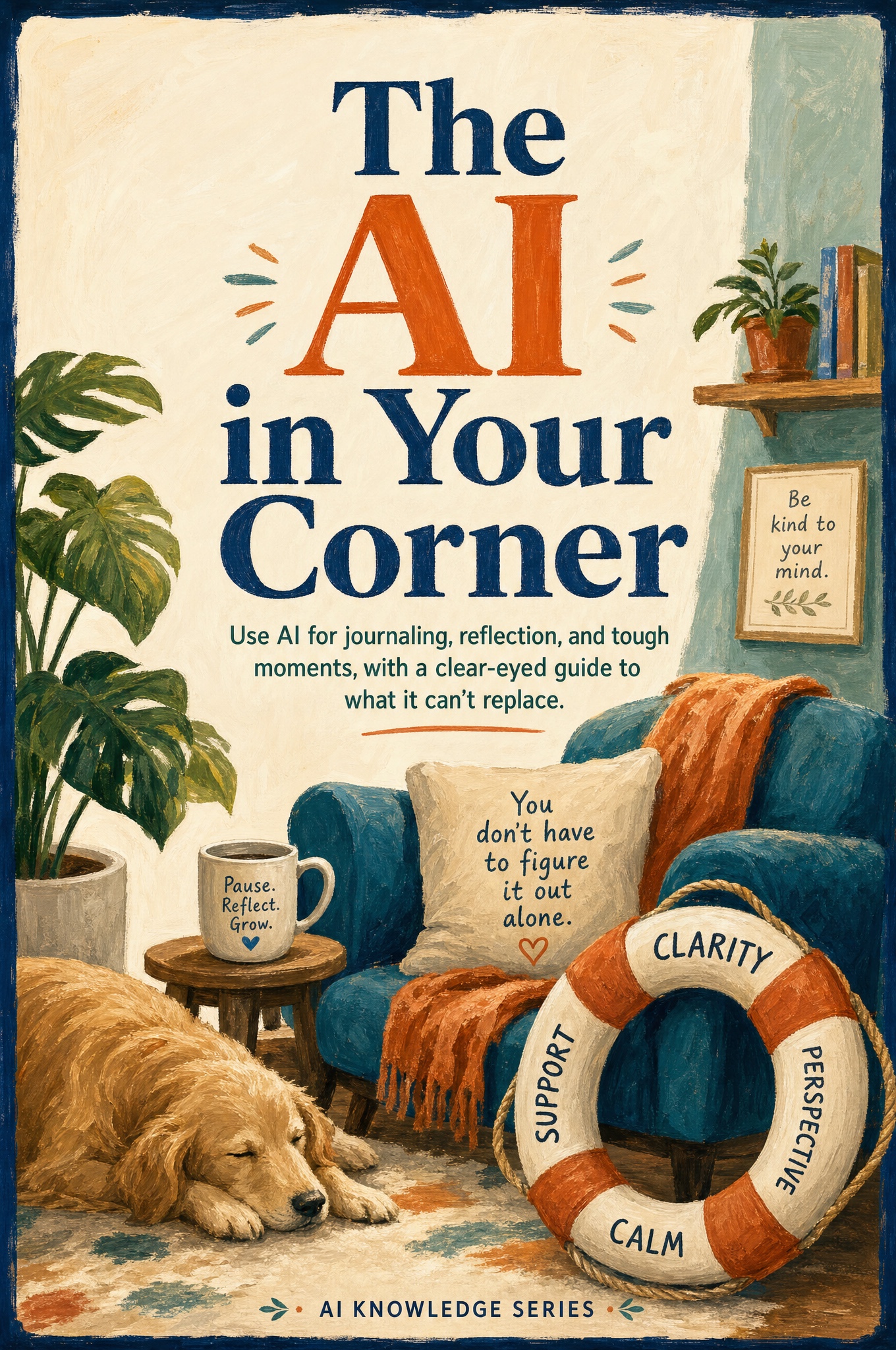
You'll understand, in plain terms, how conversational AI works, why it can feel like a thoughtful listener, and what that 'thoughtfulness' really is under the hood. You'll know the honest scope of the practice: AI as a private thinking partner for journaling and reflection, not a therapist, oracle, or friend.
Here's a small experiment. Open whatever AI tool you've been using for this practice and ask it nothing. Once you've learned to use it well, the real question is what's left when you stop.
For anyone who wants to use AI for journaling, reflection, and hard moments, while staying honest about what it can't replace.
The night you most want a private place to think is usually the night you realize you don't have one. Your notes app syncs to three devices and a backup you forgot about.
You know the feeling. You closed the app a little emptier than when you opened it.
A conversation from earlier keeps replaying, each loop adding a sharper edge. You reach for your phone, open the AI you've been journaling with, and type out the whole tangled mess.
You have a real decision in front of you right now — whether to take a new role, end something, move, say yes, say no.
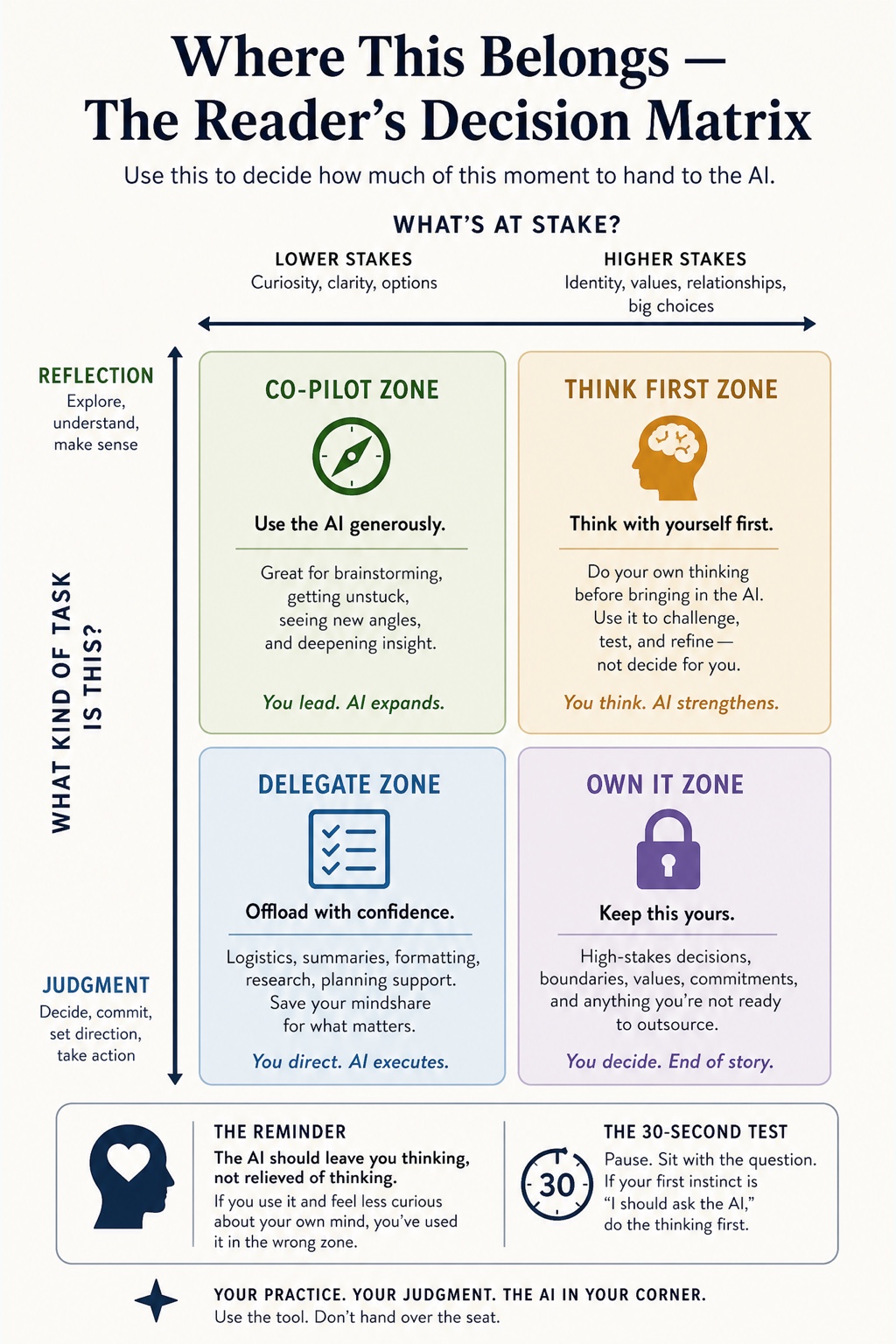
Most disappointment with AI reflection comes from asking the wrong kind of thing. The tool is a mirror, so what you get back depends almost entirely on what you put in front of it. A hollow prompt like 'Should I quit my job?' asks the AI to be the authority and outsources the judgment you should keep.
Copy this into the top of your journal or a notes file and keep it visible. These are your rules, not the app's. MY PRIVATE CORNER - GROUND RULES.
Don't open with the hardest thing in your life. Open with something small and real, so you're testing the tool and not your nerve. Pick a minor moment from today — a conversation that went slightly off, a task you kept avoiding, a small win you brushed past — then run a short, low-stakes reflection to try it out.
Say you write, 'I snapped at my partner over the dishes and I don't know why.' A hollow exchange replies, 'Conflicts about chores are often not really about the chores — try using I statements.' Accurate, generic, and finished. You learned nothing about you.
EPUB, PDF, and HTML are included so the book can work on an e-reader, as a designed copy, or as a searchable desk reference.
For e-readers and reading apps.
The designed edition with diagrams and layouts intact.
Searchable, copy-pasteable, and practical as a reference.
Yes. You get the complete edition, including the chapter sequence and internal materials described on this page.
EPUB, PDF, and HTML are included so you can read on an e-reader, keep a designed copy, or use the searchable browser version.
Because this is an instant digital download, broad change-of-mind refunds are not offered after the files have been accessed. Refund requests are reviewed within 7 days for duplicate purchases, accidental purchases before access, access failures we cannot fix, wrong files, corrupted files, or pages that materially misdescribe the book.