Who it is for
For researchers, grad students, and scientists who need to run literature reviews, wrangle datasets, and draft papers.
Run literature reviews, wrangle datasets, and draft papers with AI you can defend.
A doctoral student in clinical psychology fed forty abstracts into a chatbot, asked for a synthesis, and pasted the result into a draft introduction. Three of the citations did not exist. The question is no longer whether to use AI in research.
Two graduate students in the same lab both used AI to screen abstracts last month. One kept a versioned prompt file, logged the model and date, and exported ASReview's decision log to the shared drive — and only one of them could prove what they did.
For researchers, grad students, and scientists who need to run literature reviews, wrangle datasets, and draft papers.
You learn to test any AI search assistant before trusting it. Ask it for "all randomized trials of spaced repetition in adult second-language learning since 2015," and you'll recognize the tidy paragraph of plausible studies for what it is.
You see how a reviewer at a mid-tier neuroscience journal flagged a submitted 2026 manuscript for a reference that did not exist — a DOI that resolved to nothing — so it never happens to yours.
You can have a results section that is correct and analysis notes you can defend line by line, and still not have a paper. You learn to close that last gap.
You're ready when, three weeks after submission, a desk editor emails a single line: "Please describe any use of generative AI in the preparation of this work, per our policy.".
Have you classified the task as generation (produce candidates) or assertion (state facts)? Assertions get verified, always. Can you name the ground truth you'll check the output against — a source text, a known result, a manual spot-check?
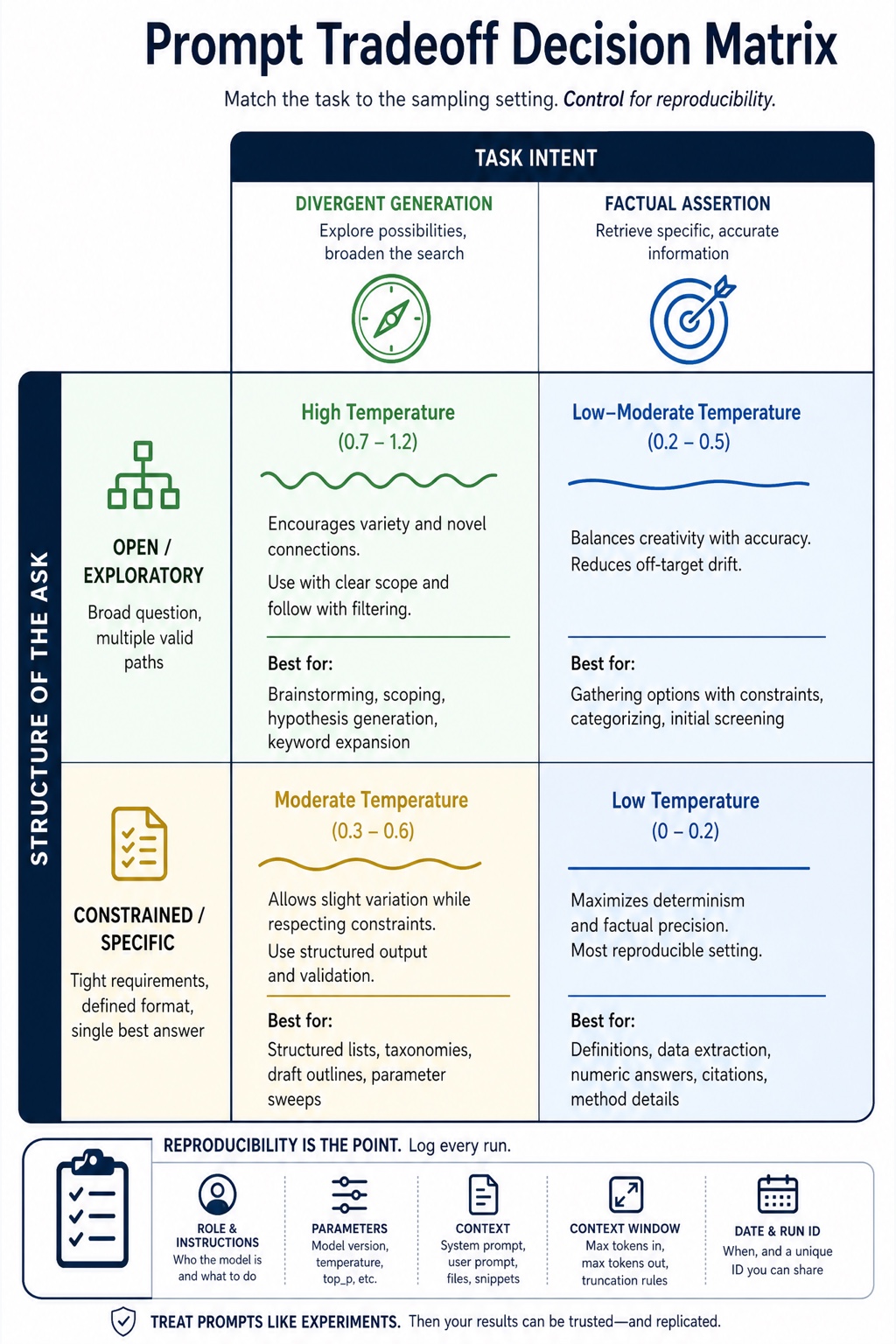
Do this once and you have a template for every project afterward. Take a prompt you used this week and rewrite it with explicit role framing, one hard constraint, and an uncertainty instruction. Run it twice at temperature ~0.2 to confirm the outputs are near-identical, then once at ~0.8 to watch the output widen.
Every prompt has parameters whether you set them deliberately or not. Make them explicit and you can vary one at a time, like any controlled experiment — starting with role framing, where telling the model who it's acting as constrains the distribution of likely outputs.
You're scoping a review and you ask a general model to "suggest search terms for studies on the worked-example effect in undergraduate statistics." You get fourteen terms. Useful. You paste them into a database, get a reasonable yield, and move on — until you try to run it again.
EPUB, PDF, and HTML are included so the book can work on an e-reader, as a designed copy, or as a searchable desk reference.
For e-readers and reading apps.
The designed edition with diagrams and layouts intact.
Searchable, copy-pasteable, and practical as a reference.
Yes. You get the complete edition, including the chapter sequence and internal materials described on this page.
EPUB, PDF, and HTML are included so you can read on an e-reader, keep a designed copy, or use the searchable browser version.
Because this is an instant digital download, broad change-of-mind refunds are not offered after the files have been accessed. Refund requests are reviewed within 7 days for duplicate purchases, accidental purchases before access, access failures we cannot fix, wrong files, corrupted files, or pages that materially misdescribe the book.