Who it is for
For anyone who needs more than vendor self-assessments — a practical way to track AI risk and hold every part of their AI stack accountable.
Build a practical AI risk-tracking system that goes beyond vendor self-assessments to establish real accountability across your AI stack.
A procurement form lands in your inbox: a vendor selling your team an AI contract-review tool attaches a security questionnaire, a SOC 2 report, and a two-page "Responsible AI" statement. The gap between what a vendor discloses and what your organization is answerable for is the problem this book solves.
You can fill a shared drive with an inventory, a scored register, an ownership map, a mitigation plan, a framework crosswalk, and a maintenance routine — and still not have a running system. The gap between a finished document and a working discipline is not more documentation.
For anyone who needs more than vendor self-assessments — a practical way to track AI risk and hold every part of their AI stack accountable.
You stop relying on the short, confident list a department head gives you — the licensed chatbot, maybe a coding assistant, maybe the meeting transcriber. You ask the team directly and surface the AI tools actually in use.
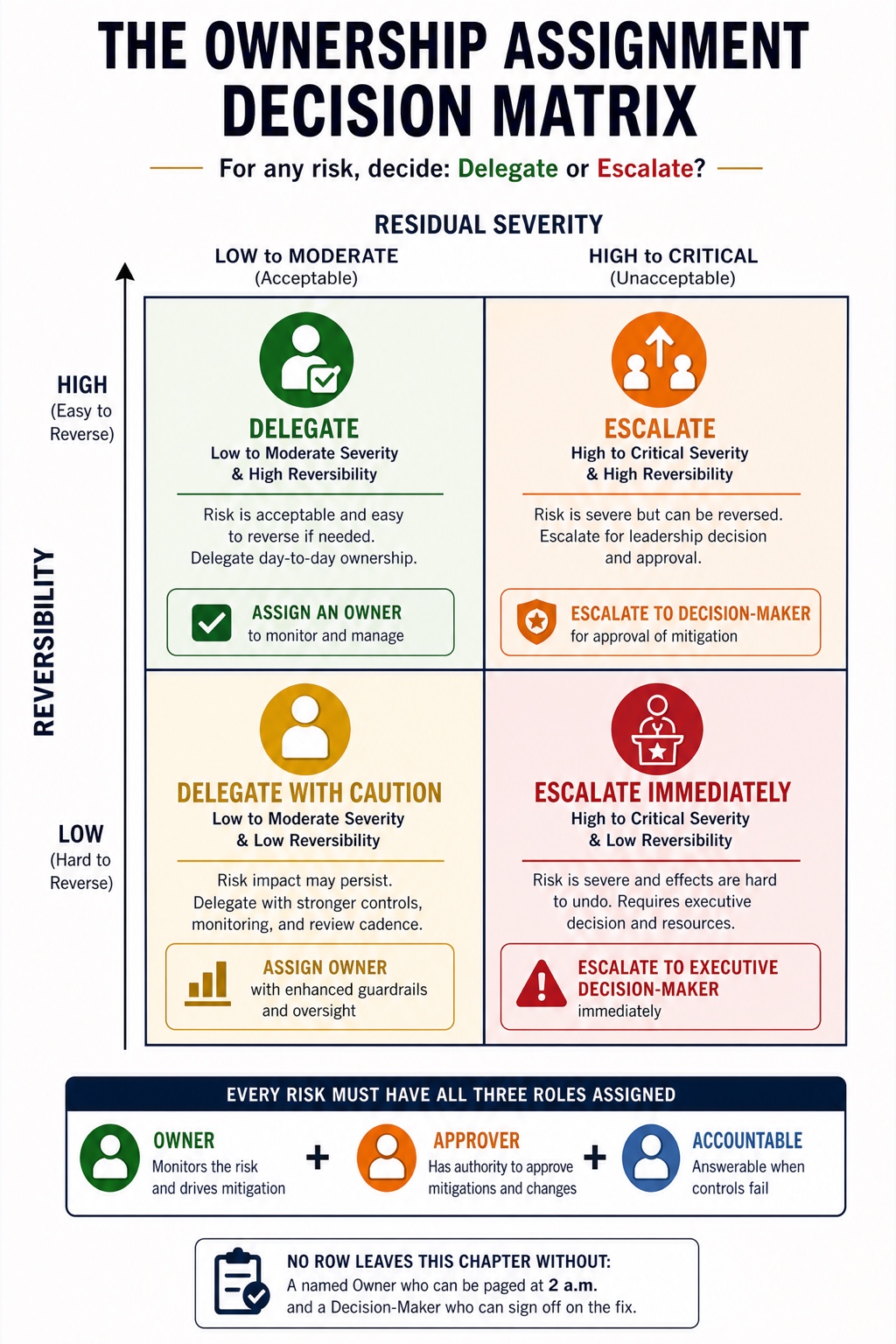
You make sure no risk has a score but no name. When a résumé-screening tool filters out qualified applicants by school or ZIP code, or a pricing tool overcharges a segment, you already know who answers — before leadership asks.
You answer the auditor who says "Show me how this AI system meets your obligations under the EU AI Act" straight from the register you already keep — no separate scramble.
You catch the register that looks healthy from across the room — rows filled, fields complete — but has quietly drifted out of step with reality.
You are ready to move to another chapter when you can answer yes to most of these for at least one system.
Use this scorecard after the worksheet. Mark each row weak, usable, or strong, and fix anything weak before moving into the full inventory. For "both taxonomies applied," weak means risks carry only topic labels like "privacy" or "bias"; usable means most risks have causal and domain reads, with a few unclear cases.
Take a concrete situation you can verify against your own stack. Your marketing team uses an AI image generator for ad creative. A generated image reproduces a recognizable trademarked logo in the background, and the ad runs for two days before anyone notices.
EPUB, PDF, and HTML are included so the book can work on an e-reader, as a designed copy, or as a searchable desk reference.
For e-readers and reading apps.
The designed edition with diagrams and layouts intact.
Searchable, copy-pasteable, and practical as a reference.
Yes. You get the complete edition, including the chapter sequence and internal materials described on this page.
EPUB, PDF, and HTML are included so you can read on an e-reader, keep a designed copy, or use the searchable browser version.
Because this is an instant digital download, broad change-of-mind refunds are not offered after the files have been accessed. Refund requests are reviewed within 7 days for duplicate purchases, accidental purchases before access, access failures we cannot fix, wrong files, corrupted files, or pages that materially misdescribe the book.