Who it is for
For anyone who wants a searchable, AI-powered wiki over their team's docs — so answers find themselves instead of you hunting for them.
Build a searchable, AI-powered wiki over your team's docs so answers find themselves.
Open the folder where your team keeps its docs and count the files: onboarding guides, runbooks, postmortems, vendor contracts, a Slack thread pasted into a Google Doc, three slightly different versions of the same process. You'll learn how to end that cycle for good.
The first sign that a knowledge base has died is silence — nobody complains, they just stop trusting it. You'll learn to catch that decay before it sets in.
For anyone who wants a searchable, AI-powered wiki over their team's docs — so answers find themselves instead of you hunting for them.
You give the AI a place to put everything and clear rules for how to write it. No more inconsistent pages — one summary three sentences, the next three screens; one page tagging topics, the next inventing its own headings.
You turn forty source summaries, a dozen entity pages, and twenty concept pages into a connected graph — so the links between them, not luck, decide whether you find what you need.
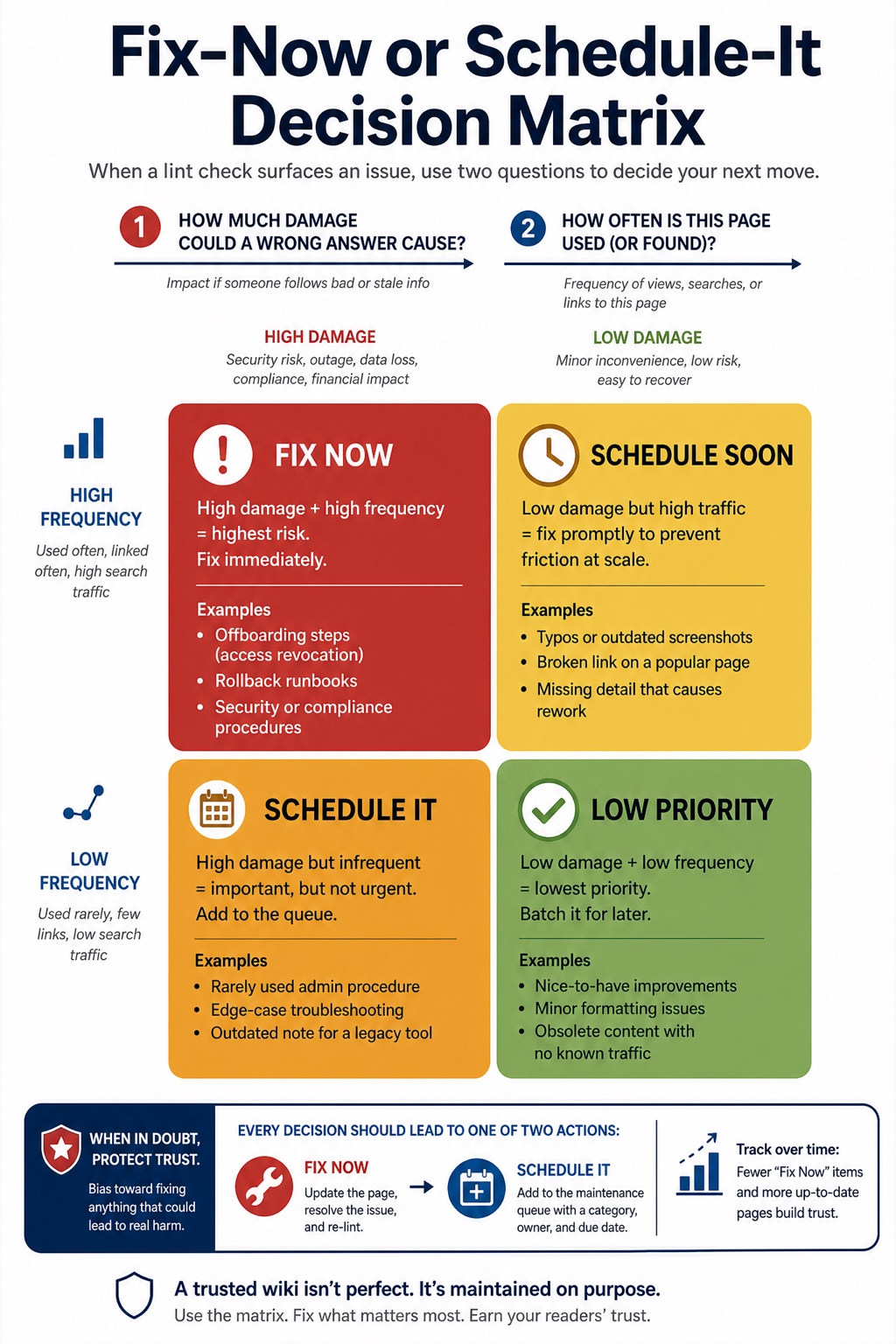
A knowledge base rarely fails all at once. You learn to spot the page that quietly went stale — like an offboarding step that still describes the old VPN procedure, leaving a departing contractor with network access for a week.
You've built something that works: ask it a question and get an answer with a citation you trust. Now you open it to your team and scale it up while keeping that trust intact.
Run these questions before you build, and write the answers down to reuse later. Volume: roughly how many documents would the wiki cover? Under ~300 is a strong signal. Repetition: name three questions your team asks more than once a month. Pain: what does a wrong or slow answer cost?
Bring the pieces together onto a single page — if it doesn't fit, your scope is too big, so cut until it does. The charter names the domain the wiki covers and why it exists.
Do this against your real charter, not a hypothetical. Create the raw/, wiki/, and wiki/sources/ folders. Add four anchor files as empty markdown: index.md, log.md, overview.md, glossary.md. Then seed the glossary with the eight to twelve terms that keep appearing in your recurring questions.
EPUB, PDF, and HTML are included so the book can work on an e-reader, as a designed copy, or as a searchable desk reference.
For e-readers and reading apps.
The designed edition with diagrams and layouts intact.
Searchable, copy-pasteable, and practical as a reference.
Yes. You get the complete edition, including the chapter sequence and internal materials described on this page.
EPUB, PDF, and HTML are included so you can read on an e-reader, keep a designed copy, or use the searchable browser version.
Because this is an instant digital download, broad change-of-mind refunds are not offered after the files have been accessed. Refund requests are reviewed within 7 days for duplicate purchases, accidental purchases before access, access failures we cannot fix, wrong files, corrupted files, or pages that materially misdescribe the book.