Specialized Professions / Advanced

The Legal Edge

Summarize contracts, draft routine documents, and research faster — without replacing your lawyer.
10 chaptersEPUB + PDF + HTMLAdvanced guide pricingDRM-free files
The Legal Edge book cover
The problem

It starts with the situation you're actually in.

A partner asks a generative model to summarize a 47-page master services agreement before a renewal call. The summary is clean, well-organized, and wrong in exactly one place — the kind of error that survives right up until it costs you.

The contract-review assistant your team standardized on six months ago may have quietly changed: its underlying model swapped, its context window resized, its citation feature repriced. Keeping your edge means catching that before it catches you.
Outcomes

What you'll be able to do.

A summary is a claim; an obligation map is evidence

You open a sixty-page master services agreement at 4 p.m., and procurement wants your sign-off by morning. You walk out with an obligation map you can defend, not a summary you only hope is right.

Use the model to scope, not to settle

You stop losing research afternoons to citations that read perfectly — the convincing case name, the plausible reporter volume, the pincite on a page that could exist, the holding that matches exactly what you hoped to prove.

Process beats memory

You avoid becoming the firm that buys a tool, runs a lunch demo, and calls itself "an AI firm" — then six months later can't say which matters touched a model while a paralegal pastes a settlement agreement into a free chatbot.

Govern the risk, not the technology

You're ready when the malpractice carrier's renewal questionnaire arrives with a new line item — describe your firm's policies governing generative AI in client work — instead of staring at a blank field.

Inside the book

A closer look at the work inside.

Putting the doctrine to work this week

Pick the three tasks you repeat most that are high-volume and low-novelty — those are your first delegation candidates. Run each through the four gates before you trust a model on it, and write down which gate, if any, it fails.

The spine: augmentation, not substitution checklist

  • Pick the three tasks you repeat most that are high-volume and low-novelty. Those are your first delegation candidates.
  • Run each through the four gates before you trust a model on it. Write down which gate, if any, it fails.
  • For every contract summary, require clause-level citations and check the two or three terms that carry the most risk.
  • Add a [VERIFY] / [ATTORNEY DECISION] framing line to your standing prompts so output arrives pre-sorted for review.
  • Never let model output reach a client or court without a lawyer adopting it as reviewed work. Make that a process rule, not a personal intention.

Classify before you trust

Before your next AI-assisted task, run a thirty-second triage that tells you how hard to push on the output. Name the architecture — raw chatbot, retrieval tool, or closed-corpus legal platform? If you can't tell, treat it as raw, then locate the source behind each claim.
The sentence that looked right checklist

  • Name the architecture. Is this a raw chatbot, a retrieval tool, or a closed-corpus legal platform? If you can't tell, treat it as raw.
  • Locate the source. Can the system show you the document behind each claim? No source link means no grounding, which means highest burden.
  • Find the long-document risk. Did you paste something long enough that the middle could be underweighted? If yes, re-ask with clause-level questions.
  • Date-check the claim. Does the answer depend on anything that could have changed after the model's cutoff? If yes, confirm it in an authoritative database.

The prompt is a legal instrument checklist

  • Role. Who is the model acting as? "You are a commercial contracts attorney reviewing a vendor agreement on behalf of the customer" produces a different reading than no role at all.
  • Jurisdiction and governing law. Court rules, statutory defaults, and enforceability standards are jurisdiction-specific.
  • Task and scope. What exactly are you asking for, and what are the boundaries? "Extract the termination rights" is scoped. "Tell me about this contract" is not.
  • Constraints. Length, reading level, what to exclude, how to handle uncertainty, whether to quote source language.
  • Output schema. The shape of the answer—table, numbered list, JSON, a defined set of fields. A schema turns prose you have to re-read into a structure you can audit at a glance.
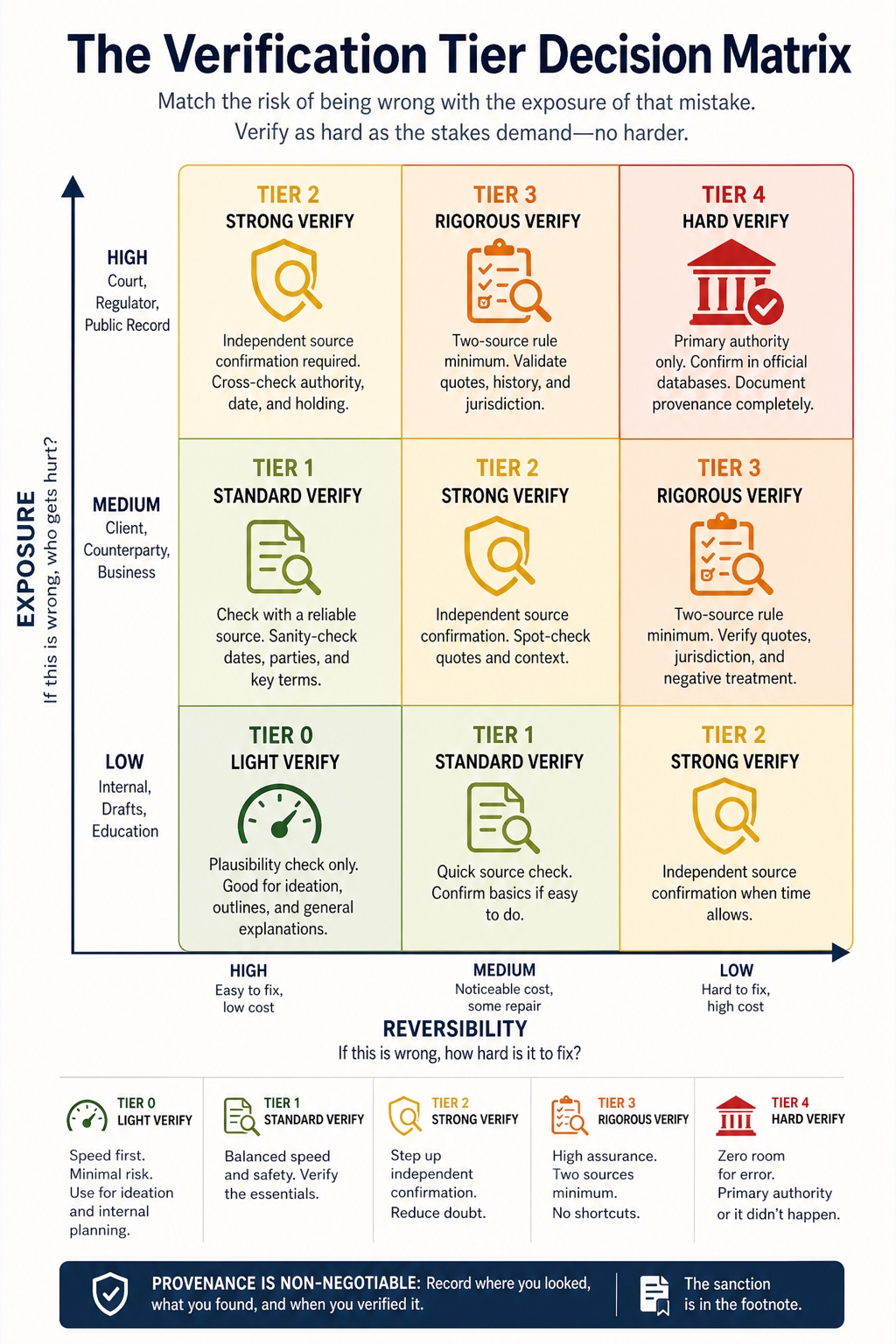
The Legal Edge visual framework
The Legal Edge frameworkInside the book
Visual preview

A diagram you can keep open while you work.

Table of contents

10 chapters, built to be read in order.

01

The Augmentation Doctrine

02

How Legal Language Models Actually Behave

03

Prompting as a Drafting Skill

04

Summarizing and Interrogating Contracts

05

Drafting Routine Documents at Speed

06

Researching Faster Without Losing Rigor

07

Verification and Citation Integrity

08

Confidentiality, Privilege, and Professional Responsibility

09

Designing the Firm's AI Workflow

10

Governance, Liability, and the Boardroom Case

154
Pages
16,835
Words
48
Exercises, checklists & tools
10
Chapters
Formats

Three formats. One purchase.

EPUB, PDF, and HTML are included so the book can work on an e-reader, as a designed copy, or as a searchable desk reference.

EPUB

For e-readers and reading apps.

PDF

The designed edition with diagrams and layouts intact.

HTML

Searchable, copy-pasteable, and practical as a reference.

Complete guide

The Legal Edge

$12.99
Advanced guide pricing
  • EPUB + PDF + HTML included in one purchase
  • 10 chapters from the complete guide
  • DRM-free files for your own devices
  • 7-day refund review for duplicate purchases, access issues, wrong files, or materially defective downloads
Add to cart - $12.99
Secure checkout / instant download / tax handled at checkout
Before you buy

Questions, answered.

Does this include the full book?

Yes. You get the complete edition, including the chapter sequence and internal materials described on this page.

Which formats are included?

EPUB, PDF, and HTML are included so you can read on an e-reader, keep a designed copy, or use the searchable browser version.

What is the refund policy?

Because this is an instant digital download, broad change-of-mind refunds are not offered after the files have been accessed. Refund requests are reviewed within 7 days for duplicate purchases, accidental purchases before access, access failures we cannot fix, wrong files, corrupted files, or pages that materially misdescribe the book.