Who it is for
For anyone making video, voiceovers, and audio with AI tools, without a crew or a studio.
Make video, voiceovers, and audio with AI tools — no crew and no studio required.
You learn what a one-person production house really is and map the full pipeline from idea to published asset, replacing crew roles with AI tools and reusable systems. You run the numbers on near-zero marginal cost, audit your capacity against a simple production-readiness checklist, and pick the minimum tool stack you need.
You can write a buildable spec, generate a voiceover, score it, cut a video, and ship it to two platforms. That is the real test of a one-person production house.
For anyone making video, voiceovers, and audio with AI tools, without a crew or a studio.
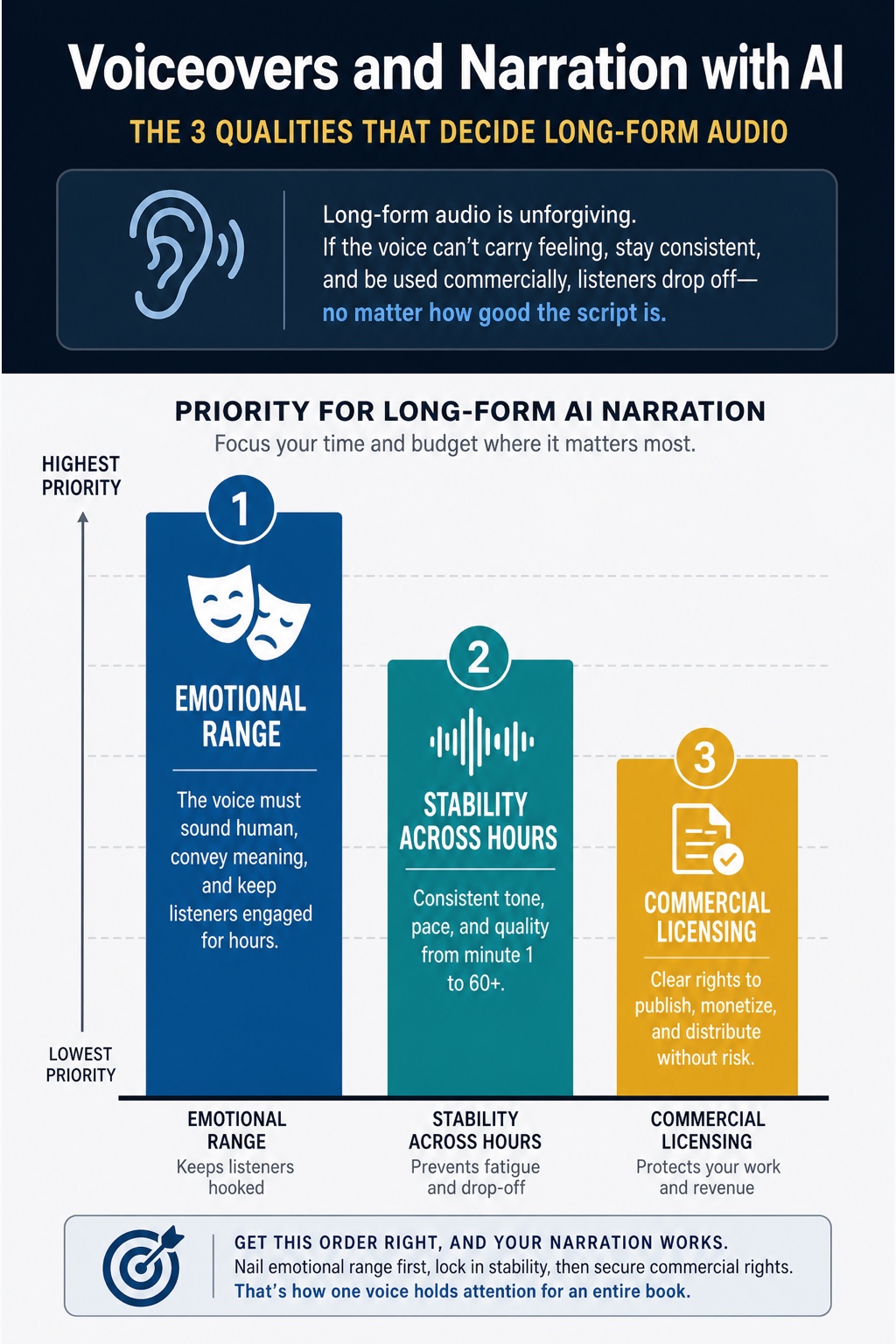
You can write a sharp script, generate a clean visual, and still lose a listener in the first ninety seconds — because the narration sounds like a vending machine reading a label. Long-form audio is unforgiving in a way short clips are not.
Your words are perfect. The episode still sounds like a voice memo recorded in an empty room.
You have a folder that tells the real story of solo production. Inside it: a voiceover export, three music stems, eleven generated video clips, two screen recordings, a logo file, and a caption sheet.
You have a polished master sitting in a folder. A finished file nobody watches is not an asset — it is a cost you have already paid with no return.
Score where you stand. This is a worksheet, not a quiz — rate each line honestly from 1 (not in place) to 5 (solid and repeatable). Under 15 means start with planning and a single medium; 15–20 means you're ready to build one full pipeline; above 20 means you can run more than one medium at once.
Two grounding sources sit at opposite ends of the production-house spectrum, and reading them side by side teaches the model better than any abstract argument. The Feisworld audiobook workflow is the narrow, repeatable case.
Fill this in for your next real project, keeping answers to one line each — if you can't compress an answer to a line, the decision isn't made yet. It pins down the outcome, the one specific audience, the format and length, and the tone in three adjectives.
Run this before any production station opens. If any box is unchecked, you're not ready to spend credits.
EPUB, PDF, and HTML are included so the book can work on an e-reader, as a designed copy, or as a searchable desk reference.
For e-readers and reading apps.
The designed edition with diagrams and layouts intact.
Searchable, copy-pasteable, and practical as a reference.
Yes. You get the complete edition, including the chapter sequence and internal materials described on this page.
EPUB, PDF, and HTML are included so you can read on an e-reader, keep a designed copy, or use the searchable browser version.
Because this is an instant digital download, broad change-of-mind refunds are not offered after the files have been accessed. Refund requests are reviewed within 7 days for duplicate purchases, accidental purchases before access, access failures we cannot fix, wrong files, corrupted files, or pages that materially misdescribe the book.