Who it is for
For anyone trying to fill their pipeline on autopilot — letting AI find leads, research them, and write the first touch.
Fill your pipeline on autopilot: AI finds leads, researches them, and writes the first touch.
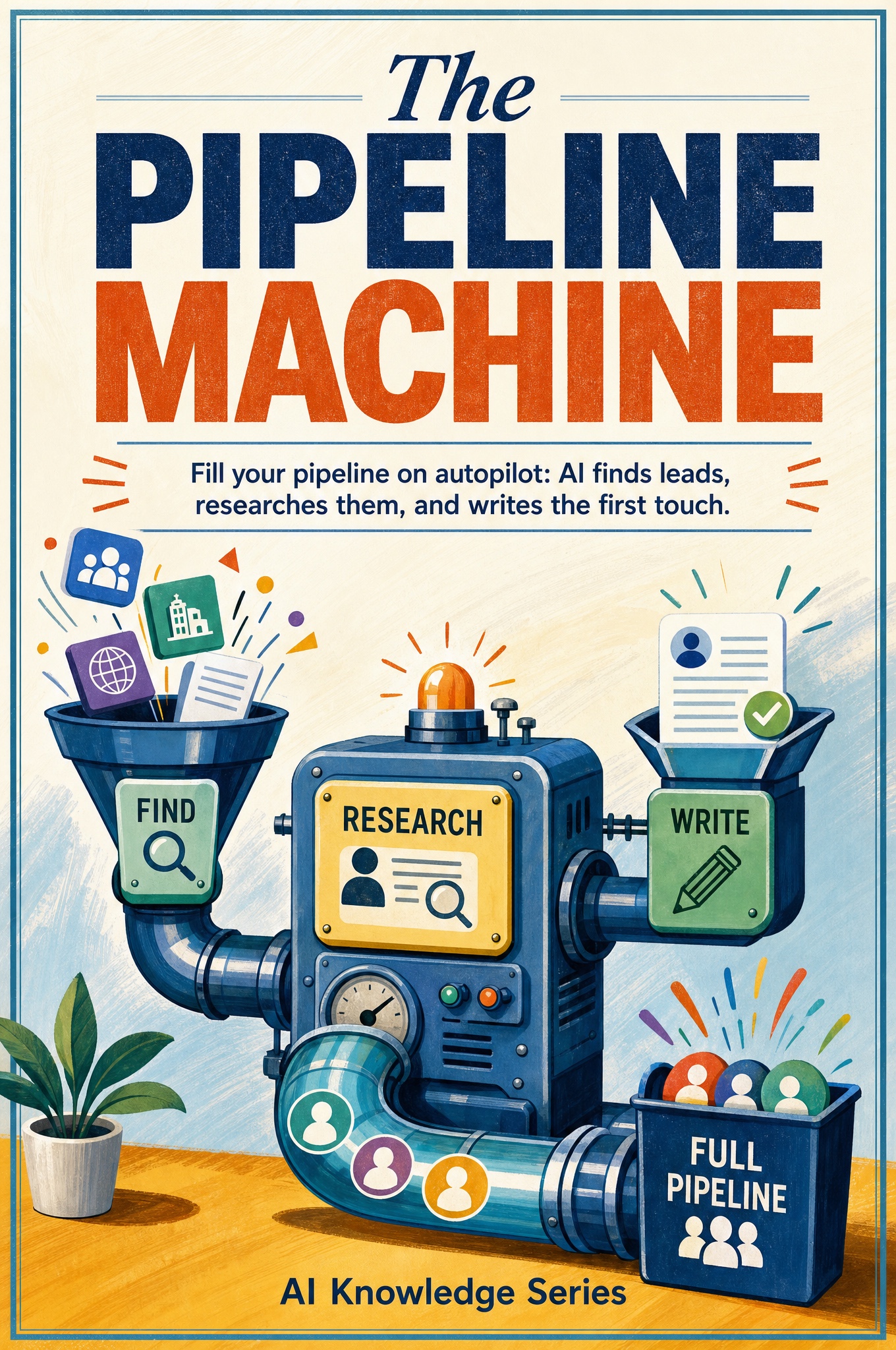
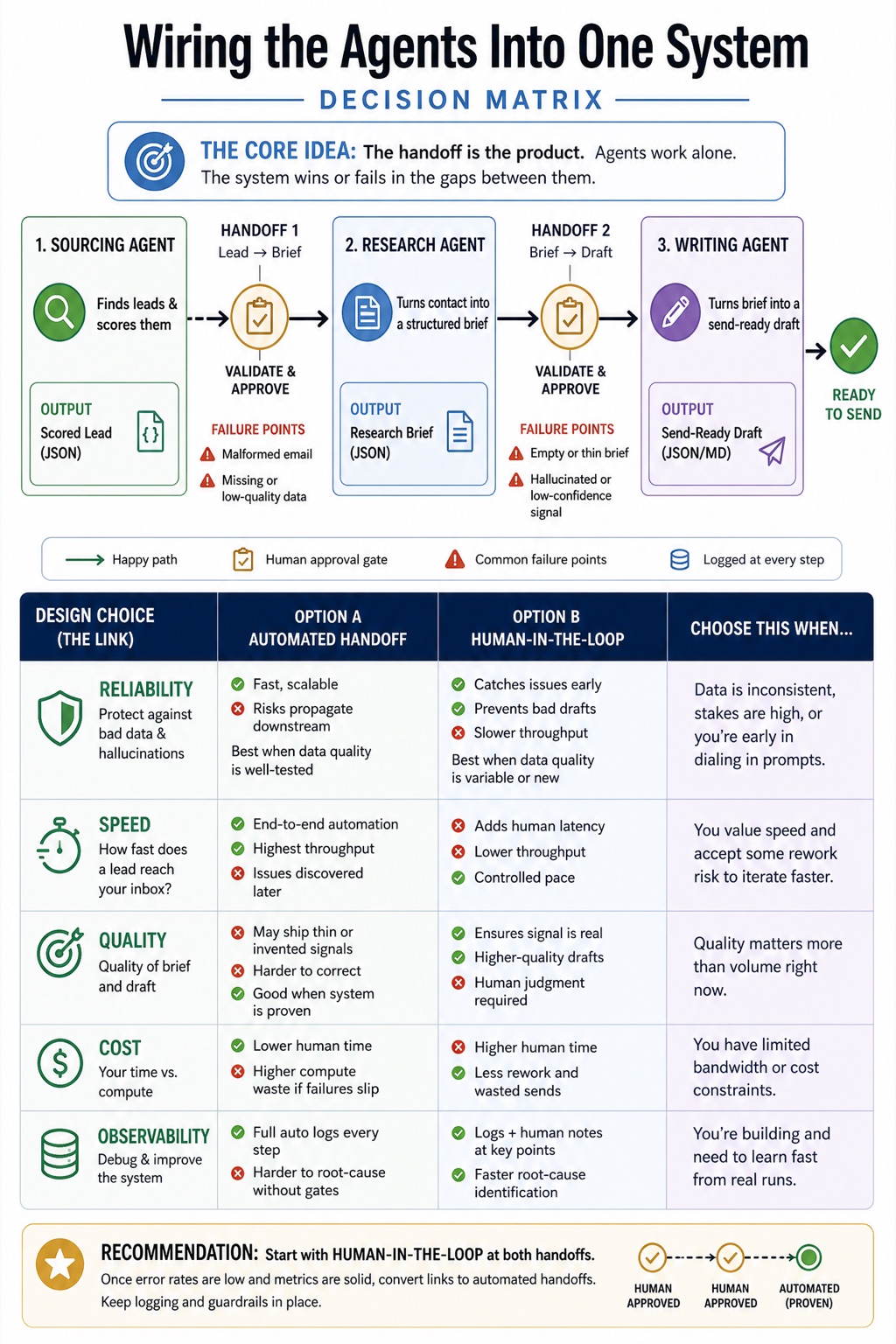
You build outbound as a sequence of single-role AI agents — one for sourcing, one for research, one for first-touch writing — instead of one all-purpose prompt, and you learn why that architecture produces better results.
You finish with every part in hand: a targeting spec, a sourcing routine, a research brief format, a writing module, a wired handoff chain, a deliverability and compliance layer, and a tuning loop. Each one works on its own.
For anyone trying to fill their pipeline on autopilot — letting AI find leads, research them, and write the first touch.
You stop relying on a list you built once — 400 contacts exported from a database tool, scrubbed over a weekend, run for three weeks. You keep it refilling instead of starting over.
You stop sending the draft that's competent and dead on arrival — the opening line every recipient has already read two hundred times.
You scale from forty sends a week to four hundred without the replies climbing for three days and then drying up. You protect deliverability as volume grows.
You answer the obvious question — is it working? — with more than "412 emails sent, 9.2% open rate." You track outcomes, not activity.
You can't automate a target you can't state. Finish this line in one sentence: We sell [offer] to [role] at [type of company] dealing with [problem] right now. If you stalled on any bracket, that's not a failure — it's the exact gap to close first.
The pattern that works comes from outside sales entirely. Builders automating long, multi-step writing workflows have converged on the same architecture: split the work into single-purpose stages instead of asking one prompt to carry the whole job. Research, drafting, fact-checking, and editing are different kinds of judgment.
Fill this in before moving on, and keep it to a single page — if it sprawls, you're describing instincts again, not fields. TARGETING SPEC — v1. COMPANY (firmographic filters): industry, employee count from ___ to ___, geography, other signals. PERSON (persona filters): titles include, department, owns this job.
Consider a team selling an onboarding-automation tool to other software companies. Their first target read: "We sell to growing SaaS companies that need better onboarding." The sourcing agent built from it returned 4,000 contacts, reply rates sat near zero, and reps blamed the copy. The target was the problem.
EPUB, PDF, and HTML are included so the book can work on an e-reader, as a designed copy, or as a searchable desk reference.
For e-readers and reading apps.
The designed edition with diagrams and layouts intact.
Searchable, copy-pasteable, and practical as a reference.
Yes. You get the complete edition, including the chapter sequence and internal materials described on this page.
EPUB, PDF, and HTML are included so you can read on an e-reader, keep a designed copy, or use the searchable browser version.
Because this is an instant digital download, broad change-of-mind refunds are not offered after the files have been accessed. Refund requests are reviewed within 7 days for duplicate purchases, accidental purchases before access, access failures we cannot fix, wrong files, corrupted files, or pages that materially misdescribe the book.