AI Knowledge Series / expert

The Preparedness Framework

Go beyond corporate promises: design AI preparedness policies that actually enforce risk mitigation, drawing on CSET and government frameworks.
10 chaptersEPUB + PDF + HTMLexpert guide pricingDRM-free files
The Preparedness Framework book cover
The problem

It starts with the situation you're actually in.

Published preparedness frameworks read like binding safety commitments but function as discretionary corporate promises. You'll learn to separate a policy's stated intent from its actual enforcement power — the distinction that decides whether catastrophic frontier-AI risk is actually managed.

You've taken preparedness frameworks apart. Now you assemble one — starting from the failure mode you've seen repeatedly.

Who it is for

For people who design or scrutinize AI preparedness policy and want it to enforce real risk mitigation rather than restate corporate promises.

Outcomes

What you'll be able to do.

A policy is a machine made of permissions

You can read any clause in a frontier lab's safety policy as a machine of permissions. When a model crosses a dangerous capability threshold, you say exactly what the lab is required to do — not what it vaguely intends.

The idea Carnegie put a name to

A pledge to "evaluate dangerous capabilities before deployment" sounds binding until you ask the question that matters under pressure: who decides whether today's situation triggers the evaluation? If it's the same people who want to ship, you don't have a commitment.

The Ceiling Problem

You can pressure-test a governance board that looks airtight — powers separated, overrides recorded, audit log append-only — with the question that voids most of it: who pays the board's members, and what happens to revenue if they say no?

Why a maturity score, and why now

Working from the inside out, you can read a clause for what it permits, find where commitments leak, bind discretion with if-then triggers, give evaluations teeth, allocate decision rights, and plug your policy into a government backstop.

Inside the book

A closer look at the work inside.

What this book argues checklist

  • Who decides that the threshold was reached? If the same leadership that wants to ship also controls whether the evaluation runs, the trigger is discretionary.
  • Who decides that safeguards are "sufficient"? If "sufficient" is judged internally with no fixed criterion, the gate has a dial, not a lock.
  • What happens if deployment proceeds anyway? If no one's authority is violated and no audit records the bypass, the "will not" was a "would prefer not to.".

Map the Machine Yourself

Build the reference model in your own notes. For each tracked domain — Biological and Chemical, Cybersecurity, AI Self-improvement — name the THRESHOLD: what capability level is named (High, Critical, other), and who decides a model has approached it.

The Tradeoff the Framework Is Trying to Manage

Before judging the Framework as merely weak, see the tension it sits inside. A preparedness policy must balance two failure modes: deploying a dangerous capability too soon, and binding the organization so rigidly that legitimate development stalls or the policy gets quietly abandoned as unworkable.

Your reusable leak inventory

Carry this list into any commitment review.
  • Designated-actor: Is any safeguard assigned to a role that can be reassigned, delegated, or vacated by the person it constrains?
  • Unbound-overseer: For every oversight body named, is there a sentence that forces it to act on a specified trigger?
  • Review-not-action: Does each threshold produce a constraint that holds, or only a discussion that can end in "proceed"?

A commitment leaks at its weakest binding, not its strongest promise checklist

  • Designated-actor: Is any safeguard assigned to a role that can be reassigned, delegated, or vacated by the person it constrains?
  • Unbound-overseer: For every oversight body named, is there a sentence that forces it to act on a specified trigger?
  • Review-not-action: Does each threshold produce a constraint that holds, or only a discussion that can end in "proceed"?
  • Conditional-escape: List every "as appropriate," "where feasible," "absent exceptional circumstances," "commercially reasonable"—and name who decides the exception applies.
  • Stacking check: Do multiple leaks land on the same load-bearing safeguard? Stacked leaks compound; treat them as one critical failure, not several minor ones.
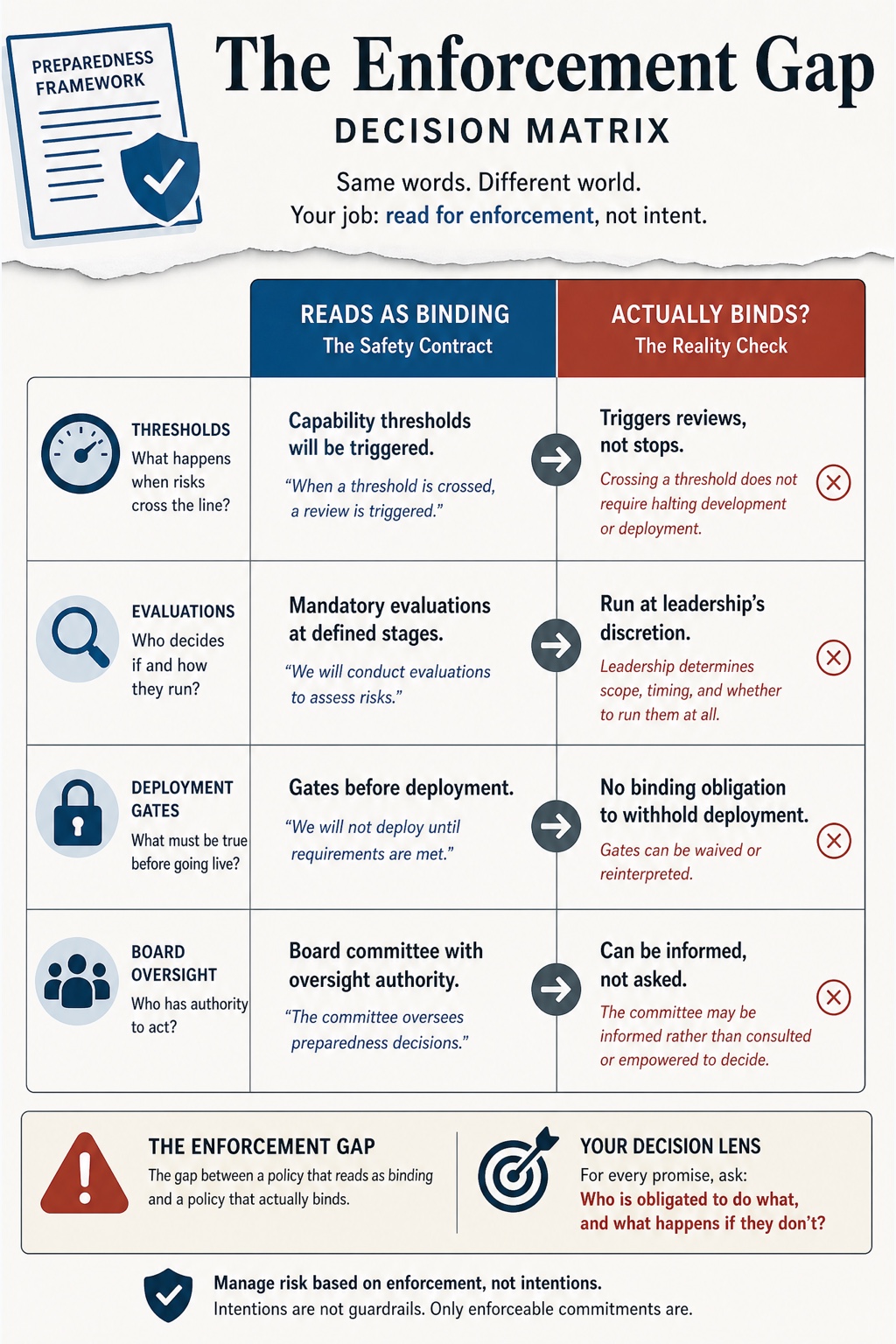
The Preparedness Framework visual framework
Map the Machine YourselfInside the book
Visual preview

A diagram you can keep open while you work.

Table of contents

10 chapters, built to be read in order.

01

The Enforcement Gap

02

Anatomy of a Preparedness Framework

03

Affordance Analysis for Safety Policy

04

Where Commitments Leak

05

If-Then Commitments That Bind

06

Designing Thresholds and Evaluations With Teeth

07

Governance Architecture for Accountability

08

Beyond Corporate Promises — The Government Backstop

09

Benchmarking Preparedness Maturity

10

Building a Preparedness Policy That Holds

158
Pages
17,539
Words
43
Exercises, checklists & tools
10
Chapters
Formats

Three formats. One purchase.

EPUB, PDF, and HTML are included so the book can work on an e-reader, as a designed copy, or as a searchable desk reference.

EPUB

For e-readers and reading apps.

PDF

The designed edition with diagrams and layouts intact.

HTML

Searchable, copy-pasteable, and practical as a reference.

Complete guide

The Preparedness Framework

$14.99
expert guide pricing
  • EPUB + PDF + HTML included in one purchase
  • 10 chapters from the complete guide
  • DRM-free files for your own devices
  • 7-day refund review for duplicate purchases, access issues, wrong files, or materially defective downloads
Add to cart - $14.99
Secure checkout / instant download / tax handled at checkout
Before you buy

Questions, answered.

Does this include the full book?

Yes. You get the complete edition, including the chapter sequence and internal materials described on this page.

Which formats are included?

EPUB, PDF, and HTML are included so you can read on an e-reader, keep a designed copy, or use the searchable browser version.

What is the refund policy?

Because this is an instant digital download, broad change-of-mind refunds are not offered after the files have been accessed. Refund requests are reviewed within 7 days for duplicate purchases, accidental purchases before access, access failures we cannot fix, wrong files, corrupted files, or pages that materially misdescribe the book.