Industry Verticals (Local & Service) / Beginner

The Restaurant Edge

Master the four levers that decide a food business's fate: menus, reviews, scheduling, and local marketing.

6 chaptersEPUB + PDF + HTMLBeginner guide pricingDRM-free files
The Restaurant Edge book cover
The problem

It starts with the situation you're actually in.

Most restaurant advice sounds like a pep talk: serve great food, treat people well, and the rest takes care of itself. It isn't wrong, but it skips the part you actually control on a slow Tuesday afternoon when sales are thin.

Picture an ordinary Tuesday. By 9 a.m. you already know roughly how many covers to expect, because last Tuesday and the three before it told you. You learn to read demand instead of guessing at it.

Who it is for

For restaurant and food-business owners who want practical control over their menus, reviews, scheduling, and local marketing.

Outcomes

What you'll be able to do.

Two Numbers Every Dish Has to Earn

You read your own menu the way a first-time guest does, with about ninety seconds before they order, and design every dish to earn its place.

The First Impression Is Now a Search Result

You win over the hungry guest three blocks away at 6:40 on a Friday who judges you by a search result, long before they ever see your dining room, smell your kitchen, or read your carefully named dishes.

The Empty Tuesday Problem

You build a schedule that holds up on a busy Tuesday—cooks cross-trained, cuts written, labor budget set—and still protects your margins when the room is quiet.

Staff the Demand, Not the Clock

You keep the line from drowning when the dinner rush hits at 7:15 on a Friday with two on the line, one in the dining room, and tickets stacking up.

Inside the book

A closer look at the work inside.

Two Numbers Every Dish Has to Earn checklist

  • Pull the numbers. Export units sold per item from your POS for the last 90 days. Cost out each recipe at current ingredient prices.
  • Calculate food cost percentage and contribution margin for every dish.
  • Sort each dish into star, plowhorse, puzzle, or dog.
  • Decide one action per dish: keep, cut, reprice, or reposition.
  • Redesign the layout so stars and puzzles sit in high-attention spots and dogs are gone.
  • Set a check date. In 30 days, compare contribution margin per cover against last quarter.

The First Impression Is Now a Search Result checklist

  • Read every review from the past 30 days across all platforms.
  • Tag each complaint by theme: speed, temperature, accuracy, service tone, noise, price, cleanliness.
  • Count the tags. Anything mentioned three or more times is a system problem, not a fluke.
  • Assign one fix to the top theme—a schedule change, a recipe step, a packing checklist—and name who owns it.
  • Watch next month's reviews for that word to fade.

Two Restaurants, Same Food, Different Fate

Two taco shops open on the same street, both making honest, good food at fair prices. One owner never thinks about reviews, so customers who loved the carnitas leave full and forget—and the only people motivated to post are the rare ones who waited too long or got a cold order.

A Calm Framework for Responding to Criticism

A bad review feels personal, but resist the urge to defend, argue, or explain why the guest was wrong. Future readers—not the angry reviewer—are your real audience, watching how you handle a problem that might someday be theirs. A graceful reply to a harsh review often wins more trust than a dozen five-star raves.
Staff the Demand, Not the Clock checklist

  • Stagger arrivals. If dinner builds from 5:00 and peaks at 7:30, don't start all four servers at 5:00. Start two at 4:30 for setup, a third at 5:30, a fourth at 6:30 for the peak.
  • Stagger cuts. As the rush fades at 8:30, send people home in order rather than keeping a full crew until close.
  • Use a call-in or on-call cushion sparingly and legally. Some places keep one person who confirms two hours out.
  • Protect the open and close. These shifts set up and reset the restaurant. Understaffing them creates the slow, messy service guests punish in reviews.
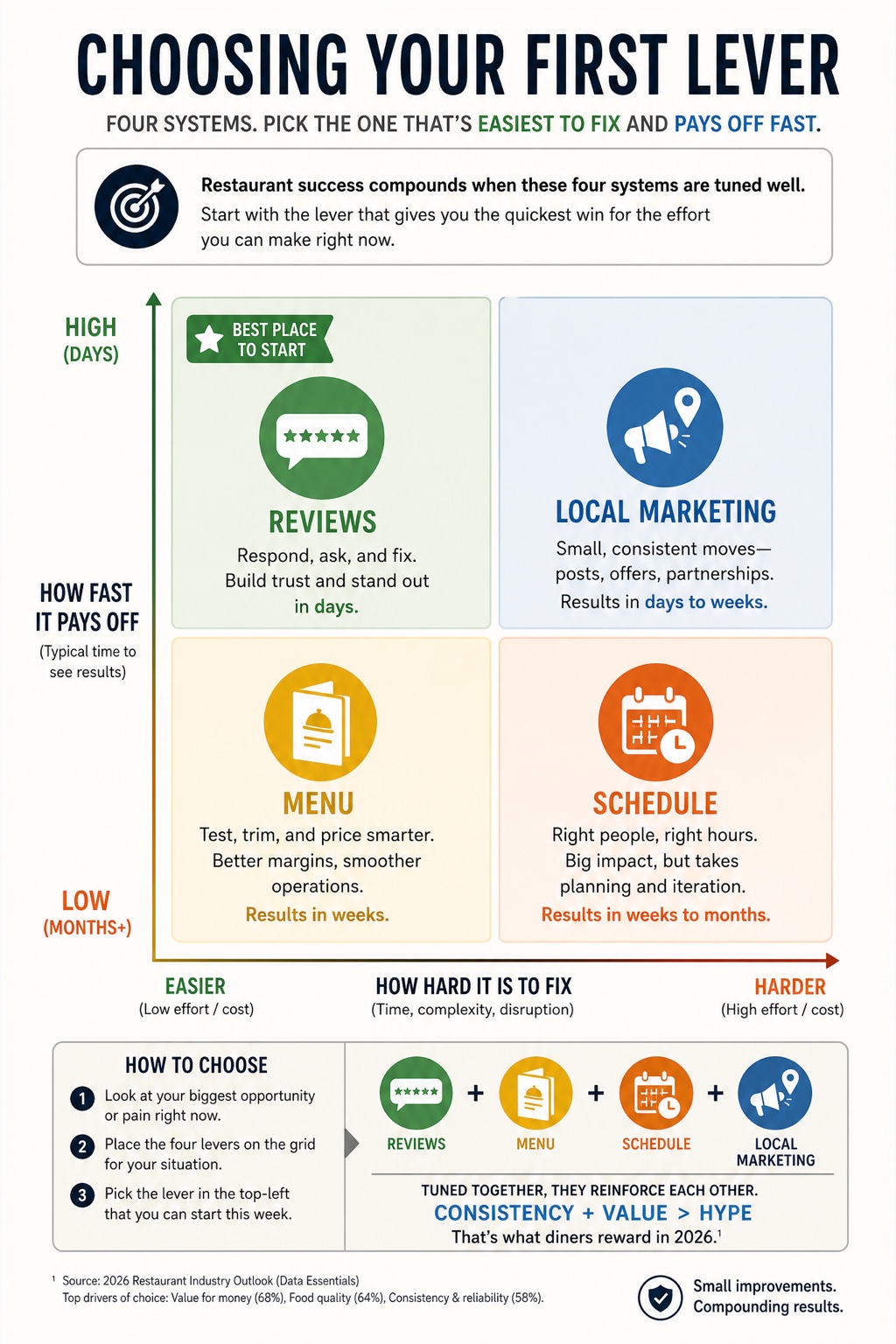
The Restaurant Edge visual framework
A Calm Framework for Responding to CriticismInside the book
Visual preview

A diagram you can keep open while you work.

Table of contents

6 chapters, built to be read in order.

01

Where the Edge Actually Comes From

02

Building a Menu That Sells and Profits

03

Turning Reviews Into Repeat Customers

04

Scheduling That Protects Service and Margins

05

Local Marketing That Brings People Through the Door

06

Putting the Four Levers to Work

122
Pages
9,537
Words
19
Exercises, checklists & tools
6
Chapters
Formats

Three formats. One purchase.

EPUB, PDF, and HTML are included so the book can work on an e-reader, as a designed copy, or as a searchable desk reference.

EPUB

For e-readers and reading apps.

PDF

The designed edition with diagrams and layouts intact.

HTML

Searchable, copy-pasteable, and practical as a reference.

Complete guide

The Restaurant Edge

$6.99
Beginner guide pricing
  • EPUB + PDF + HTML included in one purchase
  • 6 chapters from the complete guide
  • DRM-free files for your own devices
  • 7-day refund review for duplicate purchases, access issues, wrong files, or materially defective downloads
Add to cart - $6.99
Secure checkout / instant download / tax handled at checkout
Before you buy

Questions, answered.

Does this include the full book?

Yes. You get the complete edition, including the chapter sequence and internal materials described on this page.

Which formats are included?

EPUB, PDF, and HTML are included so you can read on an e-reader, keep a designed copy, or use the searchable browser version.

What is the refund policy?

Because this is an instant digital download, broad change-of-mind refunds are not offered after the files have been accessed. Refund requests are reviewed within 7 days for duplicate purchases, accidental purchases before access, access failures we cannot fix, wrong files, corrupted files, or pages that materially misdescribe the book.