Who it is for
For readers who want to capture, organize, and recall everything they read and learn — with an AI-powered knowledge system that holds onto it.
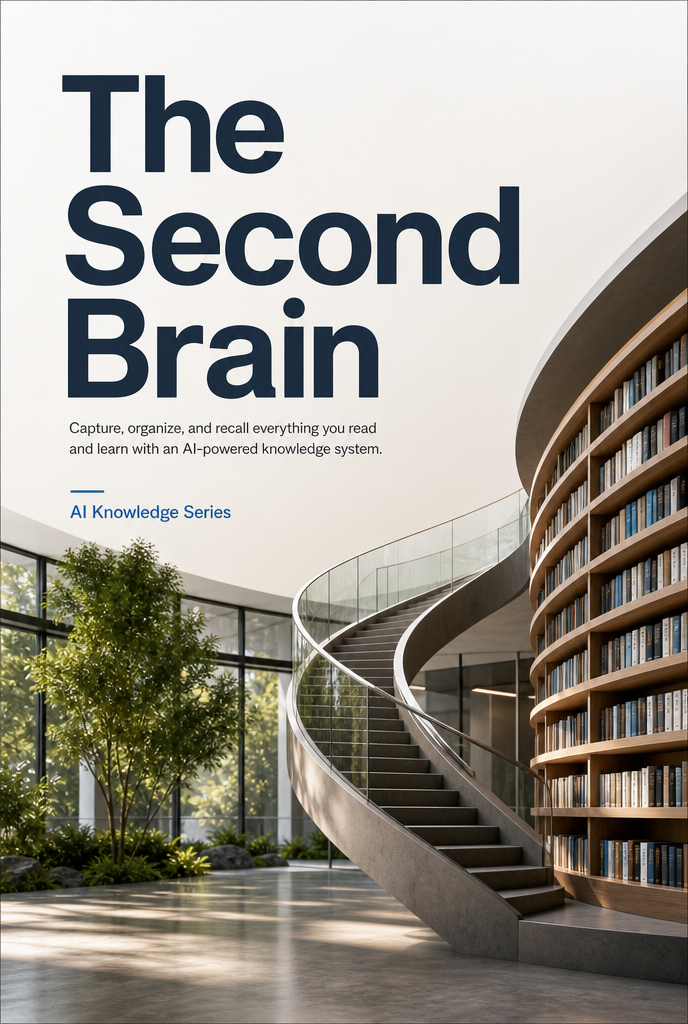
Capture, organize, and recall everything you read and learn with an AI-powered knowledge system.
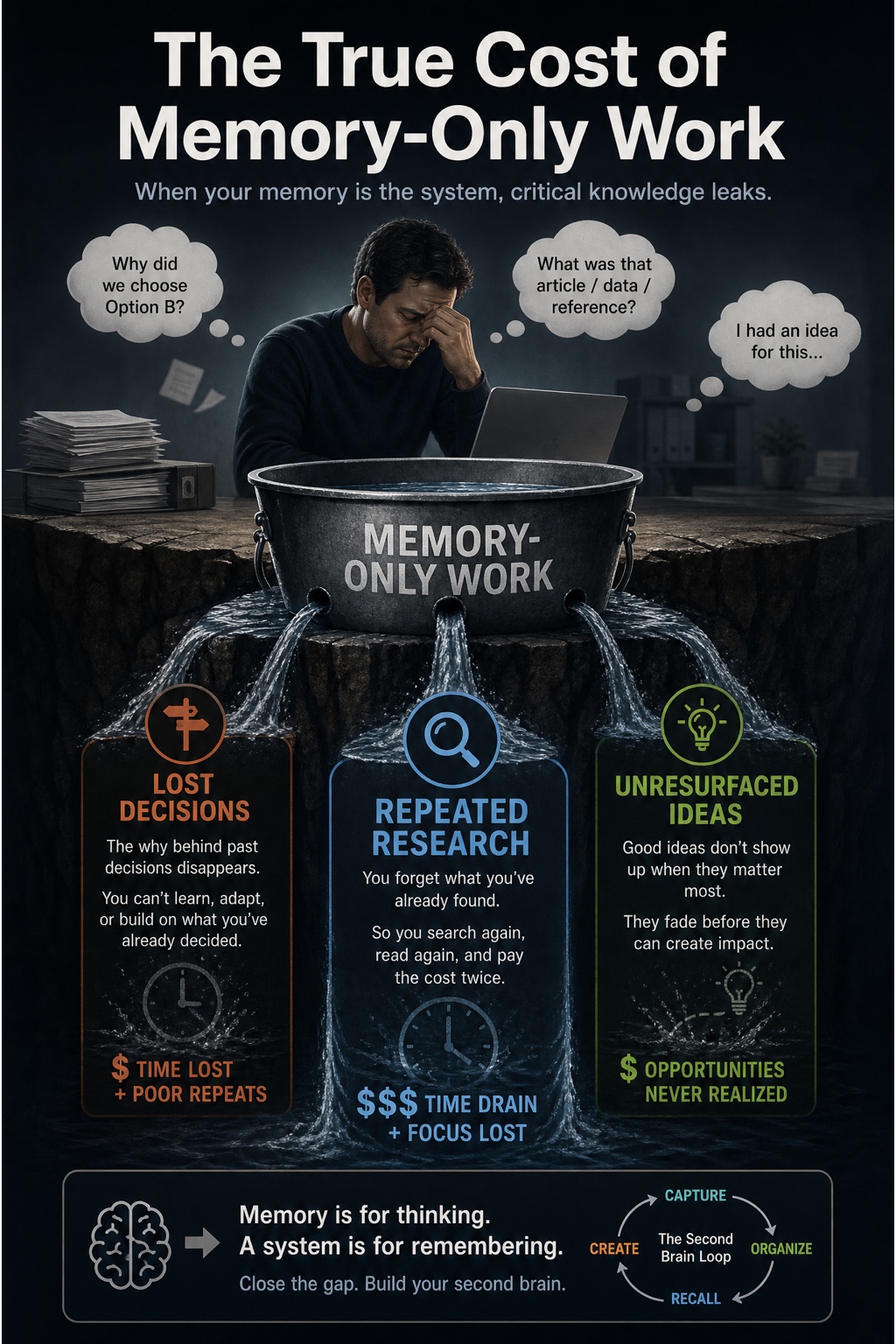
You open a document you wrote eight months ago and can't remember why you chose option B over option A. The decision is right there in the file; the reasoning that produced it is gone. You can reconstruct a story, but you can't recover the truth.
Most knowledge systems die in week two — not because the method was wrong, but because someone tried to build the whole thing at once: every folder, every automation, every source piped in, then spent three evenings tagging old notes until it felt like a second job. The fix isn't more discipline.
For readers who want to capture, organize, and recall everything they read and learn — with an AI-powered knowledge system that holds onto it.
You bring the retrieval wall down — then handle what's left. The bottleneck shifts to the doorway, where information actually gets in, and you learn to fix it there.
You capture a sharp insight — a pricing model from a March quarterly report that explained why a competitor undercut you on enterprise deals — and find it again on demand, because three search layers each do a different job.
You turn captured ideas into real output instead of expensive hoarding. You draft from what you actually own, not from what the model guesses.
A second brain fails quietly. Six months in, a decision query returns forty notes — half duplicates, a third tied to projects that shipped or died, two contradicting each other with no timestamp to break the tie. You learn to tend it so it never gets there.
Before you build anything, find out where your current system actually breaks. Fifteen honest minutes, answers written down — mental answers don't count. Start here: last week, name one thing you searched for that you'd already found before, and how long re-finding it took.
Score yourself 1–5 on the three places knowledge escapes. Capture coverage: does new information reliably land somewhere deliberate, or scatter and vanish? Retrieval by meaning: can you find things by what they're about, not the exact name or folder? Decision memory: when a past decision resurfaces, can you recover the reasoning, not just the outcome?
A pattern drawn from how knowledge workers actually operate: a tidy folder of saved PDFs, a notes app full of meeting summaries, a browser with two hundred bookmarks. By every visible measure, you are organized.
Not every professional needs every shift. A consultant who synthesizes research all day lives and dies on semantic recall and agentic drafting. A field engineer logging equipment notes may need OCR capture far more than a knowledge graph.
Tick what's true. Unchecked items are not blockers—they're the gaps to close in the chapters named.
EPUB, PDF, and HTML are included so the book can work on an e-reader, as a designed copy, or as a searchable desk reference.
For e-readers and reading apps.
The designed edition with diagrams and layouts intact.
Searchable, copy-pasteable, and practical as a reference.
Yes. You get the complete edition, including the chapter sequence and internal materials described on this page.
EPUB, PDF, and HTML are included so you can read on an e-reader, keep a designed copy, or use the searchable browser version.
Because this is an instant digital download, broad change-of-mind refunds are not offered after the files have been accessed. Refund requests are reviewed within 7 days for duplicate purchases, accidental purchases before access, access failures we cannot fix, wrong files, corrupted files, or pages that materially misdescribe the book.