AI Knowledge Series / expert

The Self-Improving Agent

Understand the architecture behind Hermes Agent's learning loop, and design systems that measurably improve after repeated tasks.

10 chaptersEPUB + PDF + HTMLexpert guide pricingDRM-free files
The Self-Improving Agent book cover
The problem

It starts with the situation you're actually in.

Most claims that an agent "learns" collapse under one question: show me the task it failed last month and passes now, without anyone touching its code. If nobody can produce that example, what's sold as learning is usually something cheaper — a longer prompt, a bigger retrieval index, a model swap.

Hermes Agent's attention was easy to see in public repository metrics and secondary write-ups, but attention is not improvement. For the live number, go to the canonical repository instead of recycled vendor summaries: <https://github.com/nousresearch/hermes-agent>. Now you can check it yourself.
Outcomes

What you'll be able to do.

A Skill Is Code the Agent Wrote for Itself

You'll see why a skill is really code an agent wrote for itself. Ask any stateless agent to repeat a multi-step task — pull the failing test names from the last CI run, group them by owning team, post the summary — and the first run gets reasoned out from scratch: parse the log, find the team field, format the output.
The Demo That Lied

You ship a learning loop, and over two weeks it logs forty successful runs of a task class — reconciling a vendor invoice against a purchase order and flagging discrepancies. You'll learn why that clean track record can still be a lie.

Trust Is Provenance Plus Reproducibility

You'll work from a concrete case: a system that, six weeks ago, synthesized a skill for triaging customer refund requests — and learn why trusting it comes down to provenance plus reproducibility.

The Gap Between Reading About a Loop and Owning One

The Hermes Agent documentation describes the pattern as a single integrated product — memory, skills, and a learning loop shipped together. You'll learn why the most common failure is treating that loop as one monolithic service.

Inside the book

A closer look at the work inside.

Is Your System Actually Self-Improving?

Run a candidate system — Hermes Agent, a competitor, or your own prototype — against these before you believe the label.

  • You can name a task class and state its success metric in one sentence.
  • You have a baseline measurement taken before any adaptation.
  • Performance rises across repeated attempts, not on a single cherry-picked run.
  • No human edited code, prompts, or parameters between the measured attempts.
  • The gain survives a fresh session (it isn't context stuffing).

Hermes Agent as a Working Case Study

For the case study to earn its place, hold it to its own claims. The documentation describes a closed loop: the agent executes a task, observes the outcome, creates or refines a skill from that experience, persists it, and reuses it later.

Instrument One Loop This Week

Pick a task class your agent already handles and run this diagnostic before you trust any improvement claim. Choose one with a one-sentence success metric, then capture a full structured transcript of three runs.

A Win That Vanishes Checklist

  • Execution is your existing agent or workflow. You change nothing here at first except: capture the full transcript, structured, every run.
  • Outcome signal is a separate evaluator — a rule, a test, a rubric, or a human check — that you trust more than the agent's own optimism. Build this before anything else automated.
  • Reflection is a distinct reasoning call with one job: given transcript and signal, name the cause and propose a lesson.
  • Skill synthesis writes the lesson into a typed, named artifact in a store you control — a file, a row, a versioned document.
  • Reuse is a retrieval step at the front of execution that pulls relevant skills into context before the agent acts.

Case Study: Tracing One Outcome Through Hermes Agent's Loop

The DeepWiki architecture page for the Hermes orange-book states the differentiator in one line: unlike agents that rely on a static toolset, Hermes "autonomously expands its capabilities." Strip the marketing and that means the system writes new procedures for itself and reuses them.

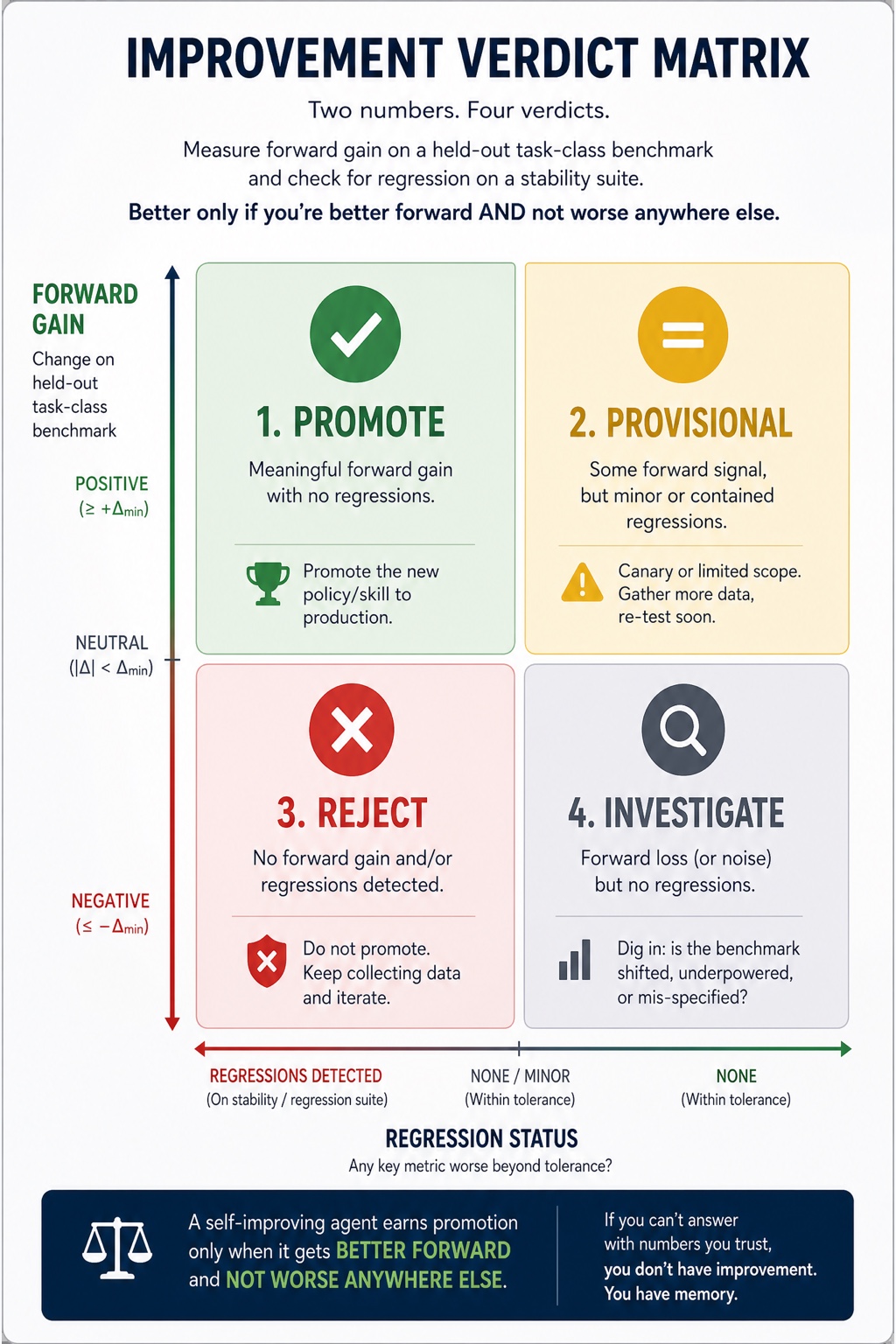
The Self-Improving Agent visual framework
The Self-Improving Agent frameworkInside the book
Visual preview

A diagram you can keep open while you work.

Table of contents

10 chapters, built to be read in order.

01

What "Self-Improving" Actually Means

02

Anatomy of a Learning Loop

03

The Three-Layer Memory Model

04

Skills as First-Class Artifacts

05

Designing the Reflection Step

06

Measuring Improvement Honestly

07

Autonomy, Scheduling, and Self-Initiated Work

08

Failure Modes and Degenerate Loops

09

Governance, Trust, and the Regulated Workload

10

A Reference Blueprint for Your Own Stack

152
Pages
16,766
Words
52
Exercises, checklists & tools
10
Chapters
Formats

Three formats. One purchase.

EPUB, PDF, and HTML are included so the book can work on an e-reader, as a designed copy, or as a searchable desk reference.

EPUB

For e-readers and reading apps.

PDF

The designed edition with diagrams and layouts intact.

HTML

Searchable, copy-pasteable, and practical as a reference.

Complete guide

The Self-Improving Agent

$14.99
expert guide pricing
  • EPUB + PDF + HTML included in one purchase
  • 10 chapters from the complete guide
  • DRM-free files for your own devices
  • 7-day refund review for duplicate purchases, access issues, wrong files, or materially defective downloads
Add to cart - $14.99
Secure checkout / instant download / tax handled at checkout
Before you buy

Questions, answered.

Does this include the full book?

Yes. You get the complete edition, including the chapter sequence and internal materials described on this page.

Which formats are included?

EPUB, PDF, and HTML are included so you can read on an e-reader, keep a designed copy, or use the searchable browser version.

What is the refund policy?

Because this is an instant digital download, broad change-of-mind refunds are not offered after the files have been accessed. Refund requests are reviewed within 7 days for duplicate purchases, accidental purchases before access, access failures we cannot fix, wrong files, corrupted files, or pages that materially misdescribe the book.