The day the analysis lied to you
You'll read the report that lands on your desk — "Top customer complaint this quarter: slow load times, mentioned 412 times" — and know why leadership shouldn't react to it yet.
Turn reviews, tickets, and surveys into product insight with AI.
Most organizations drown in feedback yet ship roadmaps disconnected from what customers actually want. You'll learn to run Voice of the Customer as an operational loop, not a survey habit.
A single review can turn into a funded fix — but three months later, the thing that sinks most feedback work happens: nobody runs it again. The spreadsheet holding your themes goes stale, and a one-time win fades. A repeatable system is the difference between a program and a performance.
You'll read the report that lands on your desk — "Top customer complaint this quarter: slow load times, mentioned 412 times" — and know why leadership shouldn't react to it yet.
Your corpus is clean, and now comes the moment most teams get wrong. You'll skip the trap of pasting a thousand rows of feedback into a chat window and typing "summarize this.".
A ranked theme is not a decision. You'll close the gap where most Voice of the Customer work quietly dies — between "customers keep raising export reliability" and "we're committing two engineers to rebuild the export queue this quarter.".
You'll pull three months of tickets and reviews, run them through your prompt library, separate the loud minority from the real pattern, and build a decision worksheet that traces a single insight from a raw quote to a falsifiable bet.
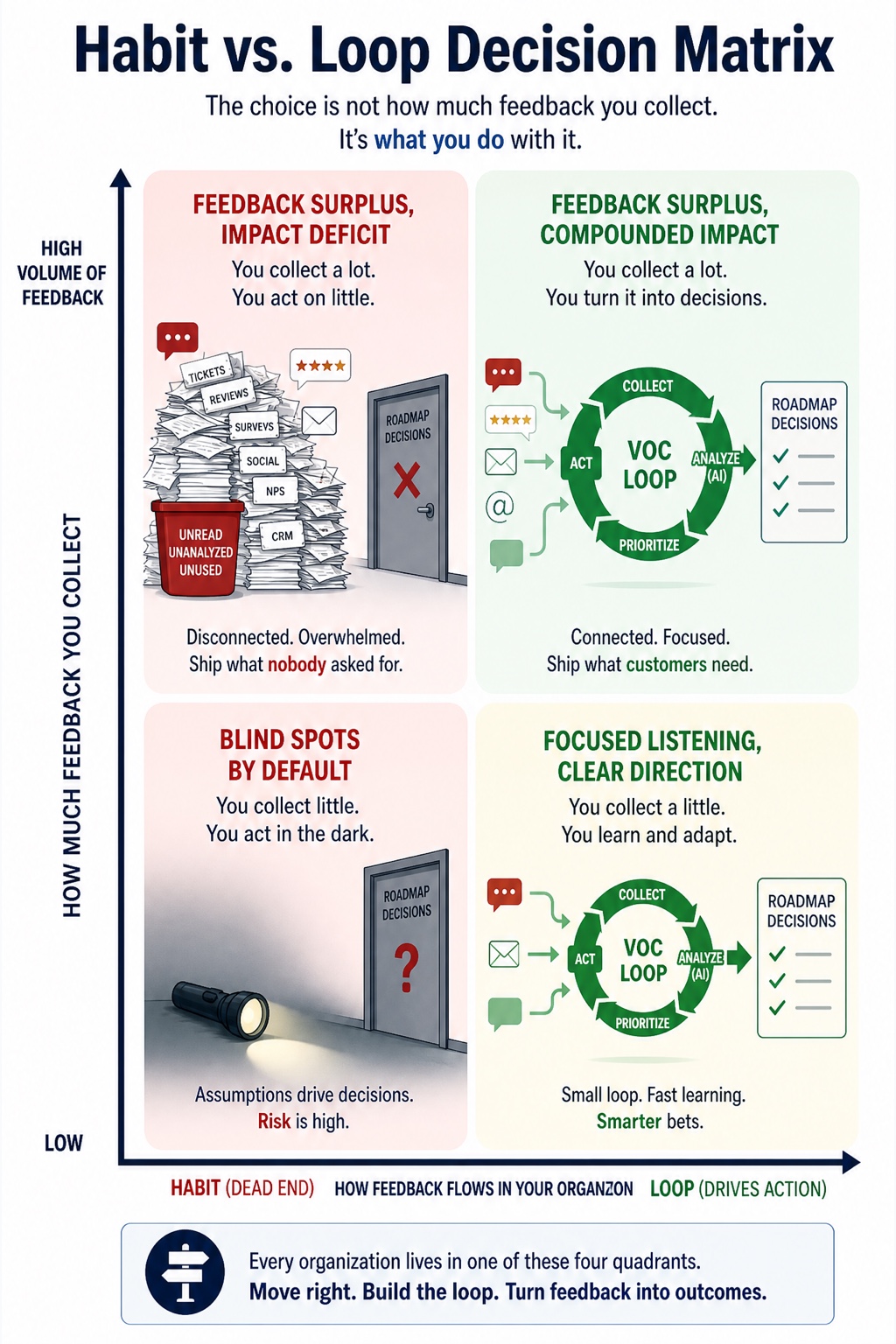
Score where your feedback loop actually breaks today before building anything new. Rate your organization on each criterion from 1 (we don't do this) to 5 (we do this reliably and someone owns it) — and be honest, because an inflated score only hides the leak you most need to fix.
Suppose a project-management tool receives this review: "I switched away because exporting my data took three support emails and two days. I just wanted a CSV." In a listening habit, it lands in the support queue, an agent apologizes, sends the export manually, closes the ticket — and the customer is already gone.
Create a simple table with one spreadsheet row per channel, and fill a row for every source you can name — even the ones you suspect are worthless, because you cannot prioritize what you have not listed. Track Source, Volume (H/M/L), main bias, signal quality (H/M/L), and whether it flows to a decision today.
EPUB, PDF, and HTML are included so the book can work on an e-reader, as a designed copy, or as a searchable desk reference.
For e-readers and reading apps.
The designed edition with diagrams and layouts intact.
Searchable, copy-pasteable, and practical as a reference.
Yes. You get the complete edition, including the chapter sequence and internal materials described on this page.
EPUB, PDF, and HTML are included so you can read on an e-reader, keep a designed copy, or use the searchable browser version.
Because this is an instant digital download, broad change-of-mind refunds are not offered after the files have been accessed. Refund requests are reviewed within 7 days for duplicate purchases, accidental purchases before access, access failures we cannot fix, wrong files, corrupted files, or pages that materially misdescribe the book.